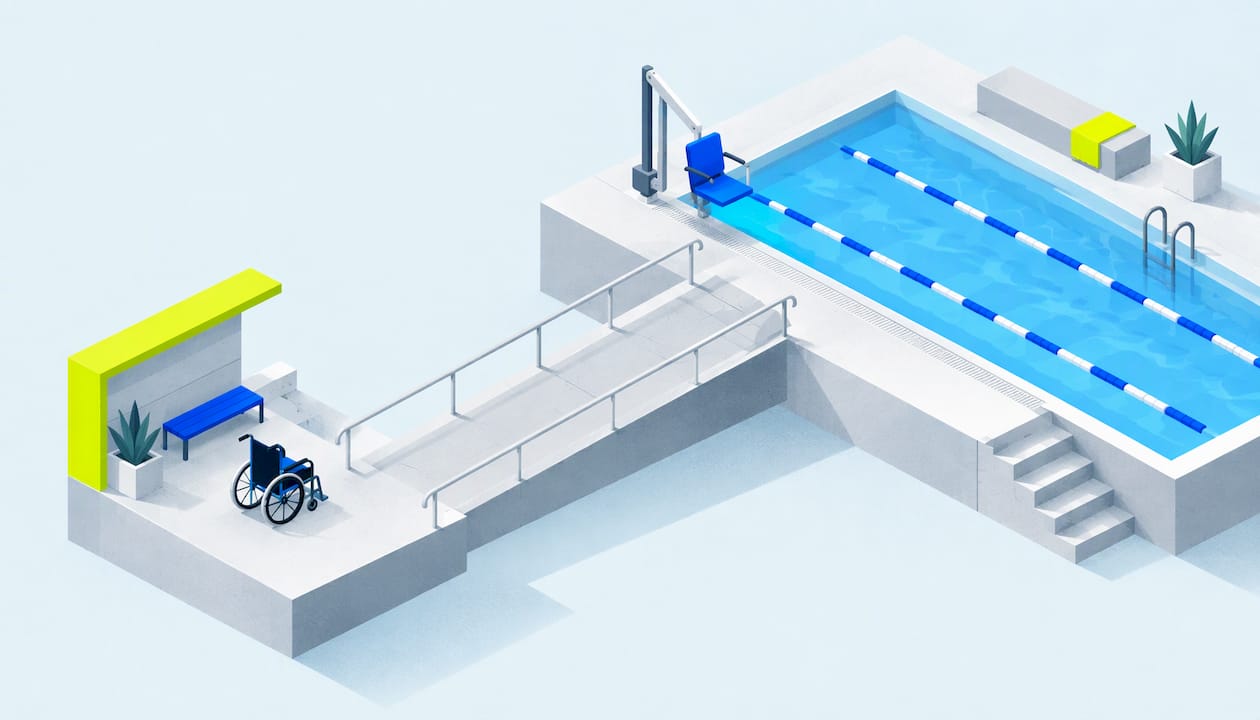
An accessible aquatics program is a swimming or water-exercise offer designed so people with physical, sensory, intellectual, neurological or other access needs can get in the water, take part and stay safe. In Australia, that means three things working together: a pool with compliant entry and change facilities, staff who know how to support individual needs, and a program built around what each participant actually wants to do in the water. This guide covers each in the order you would plan them.
TL;DR
- Start with the person, not the diagnosis. List each participant’s access needs (moving, seeing, hearing, communicating, regulating emotions) before you choose activities.
- Under the Disability (Access to Premises) Standards, a pool with a perimeter over 40 m needs at least one accessible way into the water. Check the current NCC Part D4 for the exact threshold that applies to your pool.
- Staff skills matter as much as equipment. The national unit SISCAQU012 sets out what assisting participants with a disability involves, from entry and exit to emergency response.
- Welcome, communication and the first contact decide whether people come back. Review your program against a framework such as the Swimming Australia Inclusive Swimming Framework.
Table of Contents
- What an accessible aquatics program covers
- Why it matters: water safety
- Step 1: Learn each participant’s access needs first
- Step 2: Get the physical access right
- Step 3: Build the staff skills
- Step 4: Adapt the sessions
- Step 5: Manage risk without excluding people
- Step 6: Check whether the program works
- Train your team with Inclusive-AF
- FAQ
- Sources
What an accessible aquatics program covers
The phrase is broader than “a pool with a hoist”. A good program includes:
- Lessons and water familiarisation for children and adults, one-on-one or in small groups.
- Casual or social sessions, such as relaxed swims for adults with disability, where socialising matters as much as technique.
- Water-based fitness and rehabilitation, including aqua classes and recovery sessions.
- Support systems around the water: booking, changing, communication, carers and emergency plans.
The programs that rank for this topic in Australia show the range. Local councils run disability swim programs through their leisure centres, a Brisbane group runs an adaptive program for adults and teens with physical and intellectual disability, and some providers run lessons for children and teens aged 4 to 16 with disability or neurological differences. The common thread is that the program is shaped around the participant.
Access is also wider than the physical. The Welcoming Cities inclusion guidelines for public aquatic facilities point out that people often think only of ramps and accessible bathrooms, while neurodiversity, cultural needs, economic needs and family commitments all shape whether someone can take part.
Why it matters: water safety
For many families the first reason to look for an accessible program is safety. One regional leisure centre states that, on current findings, drowning risk for people on the autism spectrum is 160 times that of the general population. Its approach combines specialised instructor training, individualised learning aligned with family needs and recognised inclusive aquatics standards.
Erika Gleeson, founder of Autism Swim, has described struggling to find any lesson service willing to take on her clients even though they sat in the highest-risk category. When a program says yes to people other services turn away, it fills a real gap.
Drowning prevention awareness campaigns, such as the World Drowning Prevention Day messages that swim schools share each July, are a useful prompt to review your own program’s safety basics each year.
Step 1: Learn each participant’s access needs first
Before you plan a single session, find out what each person needs. The Disability Gateway lists 11 categories of access barriers to consider in any activity: hearing, immunity, interacting socially, moving (upper body), moving (lower body), regulating emotions, remembering and/or concentrating, seeing, sensing, speaking, and understanding information.
Turn that list into an intake conversation. Ask:
- How do you prefer to enter and leave the water?
- What helps you understand instructions: demonstration, pictures, written steps, a sign system, a quiet voice?
- What in a pool environment can be difficult: noise, echo, bright light, cold water, crowds, changing rooms?
- Who supports you, and what role do you want them to have in the session?
- What do you want from the water: skills, fitness, fun, company, recovery?
The national competency unit SISCAQU012, Assist participants with a disability during aquatic activities, builds on the same idea. It requires workers to consider the characteristics of the participant group, assess the degree and type of support needed, decide entry and exit requirements and report any unsuitable environmental features or entry points.
A note on language that applies throughout: ask people what they need, and do not assume it from a label. Two swimmers with the same diagnosis can need very different things. This is the heart of the social model of disability, which treats barriers in the environment and in attitudes as the problem to fix. Our Social Model of Disability course covers it in practical terms for fitness professionals.
Step 2: Get the physical access right
Water entry and exit
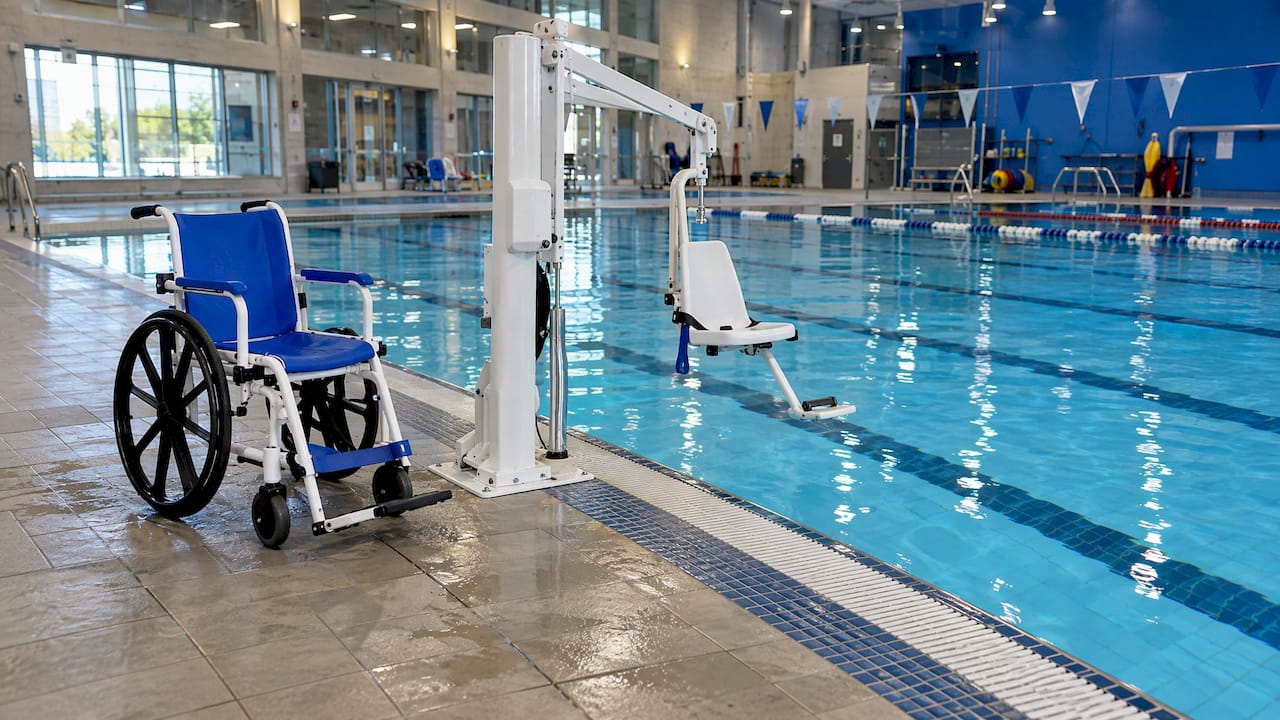
In Australia, the Disability (Access to Premises — Buildings) Standards 2010, made under the Disability Discrimination Act 1992, require at least one means of accessible water entry and exit for each swimming pool with a perimeter greater than 40 m, where the pool is associated with a building class required to be accessible. The permitted options are:
- a fixed or movable ramp with an aquatic wheelchair
- a zero depth entry with an aquatic wheelchair
- a platform swimming pool lift with an aquatic wheelchair
- a sling-style swimming pool lift
The NCC 2025 Part D4 carries the requirement forward in provision D4D11, with the same permitted methods. Perimeter thresholds and methods can differ between the Standards and the code, so confirm what applies to your pool with your building certifier or access consultant.
Compliance is the floor. A hoist that is locked in a storeroom, a ramp nobody has been trained to use, or an aquatic wheelchair with a flat battery does not give anyone access. Write down who operates each item, where it is kept and how a swimmer books it. Some Sydney councils, for example, publish how to book pool hoists, water wheelchairs and assisted entry at their aquatic centres, which is a good model for telling people what is available before they arrive.
Changing and toilets
The same Standards set out what an accessible adult change facility must include: a hoist with a safe working load of at least 180 kg and a minimum lifting height of 2,100 mm, a toilet pan with grabrails, a washbasin, a change table, changing rails, an automated sliding entrance door, signage and operating instructions.
For pool programs, changing is often where the day is won or lost. People who cannot change comfortably will not make it to the water. We cover the practical detail in our guide to accessible changing rooms.
Sensory environment
Not every barrier is a step. Echo, strong chlorine smell, glare, crowded lanes and unpredictable noise can end a session for an autistic swimmer or anyone with sensory sensitivities. Practical changes include quieter session times, a visual schedule of what will happen, a preview visit before the first lesson and a clear signal for taking a break. Our guide to autism-friendly gyms shows how the same principles carry across from the gym floor to the pool deck.
Step 3: Build the staff skills
Equipment is only as useful as the people using it. The SISCAQU012 unit, which applies to staff running learn-to-swim and water familiarisation classes in pools and confined shallow water venues, sets a clear standard for the job:
- choose communication techniques suited to each participant
- advise participants and caregivers where resources are and how to use them
- give clear information and demonstrations, and confirm understanding
- respond to questions and feedback
- observe how participants respond and adjust support as needed
- know first aid and water rescue techniques, and CPR in line with Australian Resuscitation Council guidelines
Some providers set the bar higher. One national non-profit that delivers lessons to more than 2,600 young people with disability each week says its teachers hold AUSTSWIM Access and Inclusion or Swim Australia Learners with Disability accreditation, receive yearly professional development, and use visual aids, schedules, flotation devices and tools such as Key Word Sign. They also work with occupational therapists and exercise physiologists.
A council example shows how specific training widens who can join. At one Sydney centre, six teachers have completed Puggles Swim training, which lets them include deaf and hard of hearing children in learn-to-swim classes with confidence.
The first contact
The Swimming Australia Inclusive Swimming Framework stresses that the first point of contact is very important, particularly for people who have never been in an aquatic environment or whose first language is not English. What is said, and how, sets the tone. The Welcoming Cities guidelines make the same point from the other side: it takes a second to feel excluded, so the manner of the people at the pool is vital.
Train the front desk as well as the instructors. Give everyone the same short script for questions about access, and make sure that when someone asks “can my son swim here?” the answer is “let’s work out how”, not “let me check if we’re allowed”.
Step 4: Adapt the sessions
Adaptation is about the method, not about lowering expectations. A few patterns work across many groups:
| Access need | Adaptation to consider |
|---|---|
| Moving (lower body) | Ramp, lift or zero depth entry; flotation support; time and space to transfer; shallow-end seated positions |
| Seeing | Orientation walk of the pool; tactile cues and verbal descriptions; consistent lane and equipment layout |
| Hearing | Visual demonstrations; Key Word Sign or Auslan where available; clear sightlines to the instructor |
| Understanding information | Short steps, pictures, repeated demonstration, confirming understanding |
| Regulating emotions or sensory sensitivity | Quieter sessions, visual schedule, break signal, predictable routine |
| Remembering and concentrating | Same structure each week, one instruction at a time, visual checklists |
Plan each session with a goal chosen by the participant, a simple structure that repeats, and a way to adjust on the day. Watch how people respond and change the support, as the unit of competency expects.
If you also run land-based programs, the same thinking applies. Our guides on training clients with spinal cord injury and stroke exercise adaptations set out approaches that carry into water-based work, such as managing transfers, fatigue and one-sided weakness.
Step 5: Manage risk without excluding people
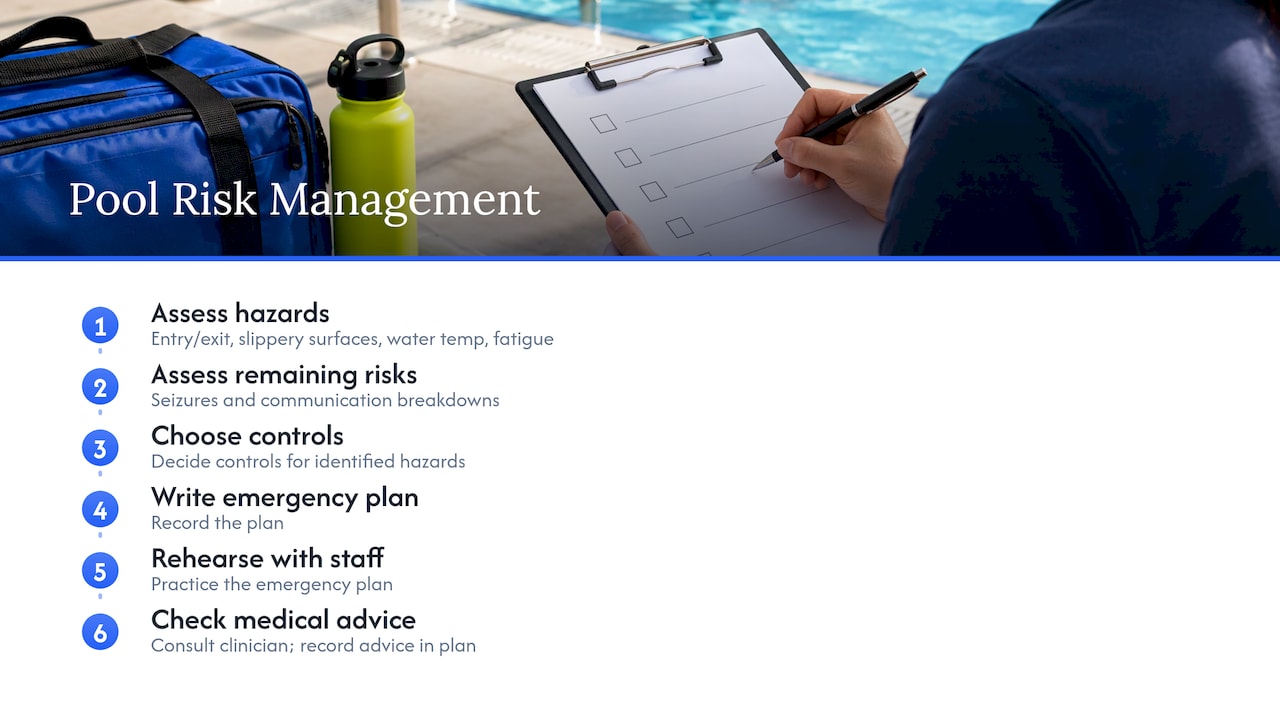
A risk assessment should make participation possible, not hunt for reasons to say no. Identify the hazards (entry and exit, slippery surfaces, water temperature, fatigue, seizures, communication breakdowns), decide the controls, and write an emergency plan that staff have rehearsed. Our disability risk assessment guide for gyms walks through the method, and it adapts readily to a pool deck.
For anyone with a specific medical condition, such as epilepsy, a cardiac condition or a recent injury, ask the participant to check water-based exercise with their doctor or treating allied health professional, and record any advice in the plan.
Step 6: Check whether the program works
Once the program runs, review it with the people who use it. The Swimming Australia framework is built around seven pillars of inclusion, including communication, and comes with a 7 Pillars Self-Assessment Tool to help identify areas for improvement. Use it each year alongside simple questions:
- Who is attending, and who is not?
- How long does it take from enquiry to first session?
- Do participants and carers feel welcome, and what would they change?
- Are equipment and staff training current?
- What did the last incident or near miss teach us?
Funding also shapes who can attend. Many participants use NDIS supports, so it helps to understand what is and is not funded in fitness settings. Our guide to NDIS and gyms explains the basics.
What we think
Most aquatic programs fail disabled swimmers long before anyone reaches the pool edge. The ramp is there, the hoist passes inspection, and yet people stay away because the booking page is confusing, the front desk is unsure, or an instructor talks to the carer instead of the swimmer.
We build our training around that gap. Our approach is practical and non-patronising, designed with people with disability, and focused on what a fitness or aquatic professional can do differently on Monday morning. We would rather you ask a swimmer what works than guess from a diagnosis.
If your team can explain the social model of disability, run a simple access conversation and adjust a session on the day, you already have most of what an accessible program needs. The equipment then does its job.
Tommy
Train your team with Inclusive-AF
A good aquatics program starts with a team that understands disability inclusion. Inclusive-AF offers online, CPD-accredited training for fitness professionals, gym owners and institutions, and our courses are built around real-world issues and lived experience rather than patronising language.
The Crash Course: Train Clients With Disability is our free introduction, so you can start without cost.
When you are ready for more, the Inclusive-AF store has History of Disability in Australia ($20 AUD, one-off) and The Social Model of Disability ($40 AUD, one-off). If you want to bring a whole team or centre through together, find out about group and team enrolment. Our basics of disability inclusion in fitness is a good place to read first.
FAQ
Who can join an accessible aquatics program?
Programs are generally open to people with physical, sensory, intellectual or neurological disability, and many include children, teens and adults. Some are for one group, such as children aged 4 to 16 or adults only. Contact the provider to discuss your needs, since most will tailor lessons around the individual.
Does every pool have to provide accessible water entry?
Not every pool. Under the Disability (Access to Premises — Buildings) Standards 2010, at least one means of accessible water entry and exit is required for each pool with a perimeter over 40 m that is associated with a building required to be accessible. The NCC 2025 Part D4 carries the requirement forward, so check the current code with your certifier.
What qualifications should instructors have?
Look for training in teaching people with disability, such as AUSTSWIM Access and Inclusion or Swim Australia Learners with Disability accreditation, plus current first aid and CPR. The national unit SISCAQU012 covers assisting participants with a disability during aquatic activities, including entry, exit, communication and emergency response.
How do I start an accessible program at my centre?
Begin with a conversation with people who would use it, then audit your entry, changing and sensory environment. Train staff, write a risk assessment, and start with a small pilot group. Review it using a framework such as the Swimming Australia 7 Pillars Self-Assessment Tool.
How can a gym team prepare before adding pool sessions?
Build the foundations first: disability awareness, the social model, communication and risk assessment. Our online courses cover these, and our group enrolment option lets a whole team learn together.
Sources
- Disability (Access to Premises — Buildings) Standards 2010
- NCC 2025 Part D4 Access for people with a disability
- SISCAQU012 Assist participants with a disability during aquatic activities
- Address access barriers, Disability Gateway
- Inclusion guidelines for public aquatic facilities, Welcoming Cities
- Swimming Australia Inclusive Swimming Framework
- Neurodiverse Swimmers, Port Hedland Leisure
- Learn to Swim, City of Ryde
- Rainbow Club Australia prospectus, March 2026
- Erika Gleeson on designing inclusive businesses
- World Drowning Prevention Day