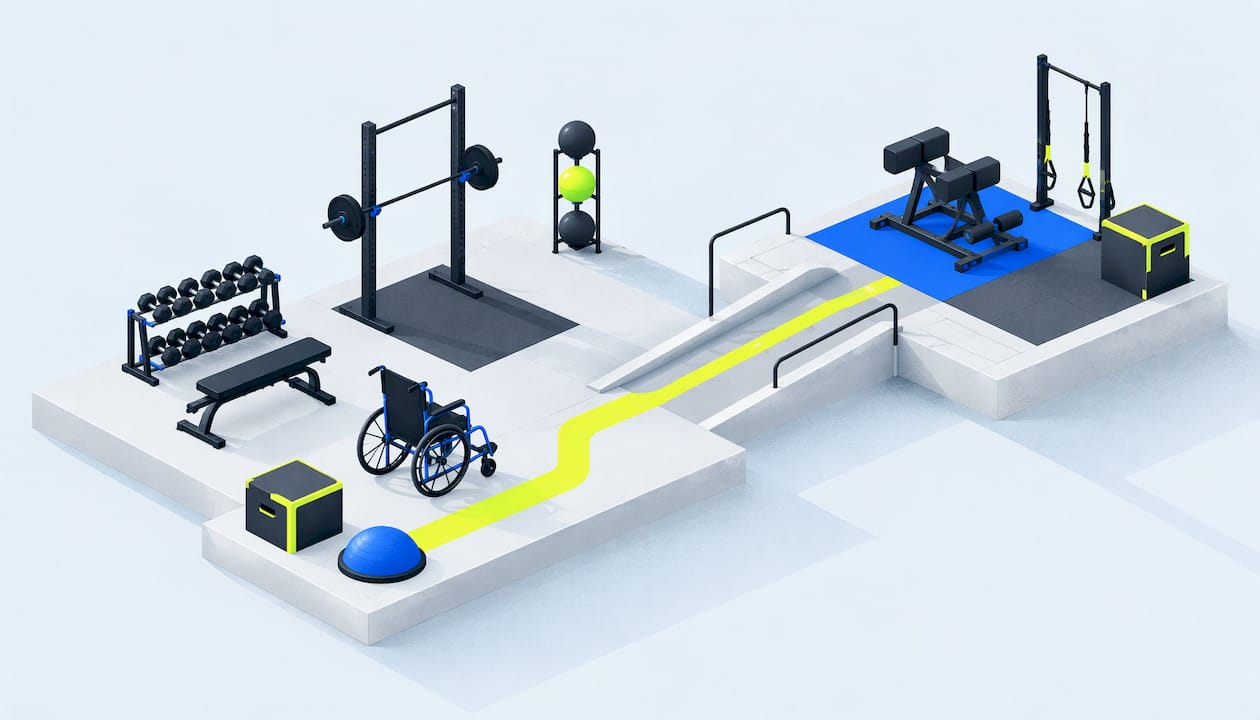
Integrating adaptive equipment well means starting with the client, not the catalogue. Choose the equipment with the person and their health professional, place it on the main floor where everyone trains, teach every staff member to use it, and review it on a schedule. Buying a specialised machine and parking it in a corner is not integration. This guide walks through each step for Australian gyms, studios and trainers.
TL;DR
- Adaptive equipment is gear modified or built for people with disabilities. Integrating it means it sits in the normal flow of the gym, not in a separate zone.
- Ask the client about goals first. Where equipment carries safety risk, have a qualified health professional assess the person before use.
- Keep walkways clear, space equipment for mobility aids, and offer guided introductions and simple signage.
- Train all staff, service equipment on a schedule and review how it is working with the client regularly.
- Cheap options such as bands and ropes often do a lot of the work. Not every solution needs a large machine.
Table of Contents
- What adaptive equipment actually is
- Examples that work in a fitness setting
- Start with the client, not the equipment
- Lay out the floor so equipment is part of the gym
- Train every person who might use or explain the equipment
- Maintain, label and inspect
- Check that it is working for the client
- Australian accessibility requirements
- Why we think integration needs training, not just kit
- Build your team’s confidence
- FAQ
- Sources
What adaptive equipment actually is
Adaptive equipment means machines, weights and other devices modified or engineered so that people with disabilities can use them more easily. The Conversation describes four kinds of adaptive fitness tools: exercise equipment and accessories, exercise machines, sports equipment and fitness apps.
In practice that covers a wide range. A strap that lets someone grip a handle is adaptive equipment. So is a rowing machine built for use from a wheelchair or a supported seat.
Adaptive equipment versus assistive devices
The two terms overlap, and clients may use either. The University of Wisconsin-Madison’s accessibility guide treats adaptive technology as a subcategory of assistive technology: something designed specifically for people with disabilities. BraunAbility puts it this way: all adaptive equipment is assistive, but not all assistive equipment is adaptive.
For a trainer, the useful distinction is simple. An assistive device is something a client may bring with them, such as a wheelchair or a communication aid. Adaptive equipment is something you provide or modify so the session works for them. Your job is to make the two work together.
Examples that work in a fitness setting
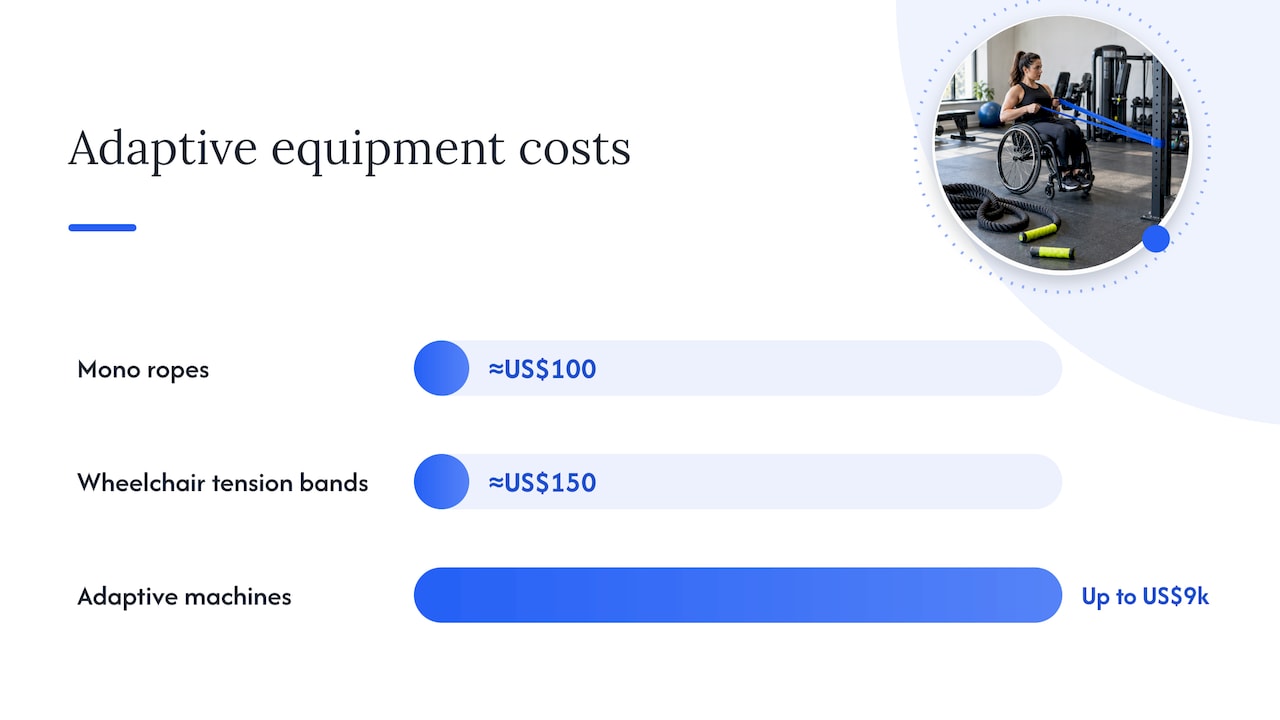
The range runs from a few dollars of accessories to serious machines. The table below uses examples and price points reported by The Conversation and NCHPAD. Prices are in US dollars as reported in August 2024, so treat them as a guide to scale and check Australian suppliers for current pricing.
| Type | Examples | Typical cost reported |
|---|---|---|
| Accessories | Mono ropes, wheelchair tension bands | About US$100 for mono ropes, about US$150 for wheelchair tension bands |
| Machines | Adaptive rowing machines, treadmills, arm ergometers | Some adaptive machines cost as much as US$9,000 |
| Sports equipment | Handcycles, adapted sports gear | Varies by item |
| Apps | Fitness apps built for accessibility | Varies by app |
Source for the costs: The Conversation.
NCHPAD notes that specialised exercise equipment can help people who use a wheelchair or have a mobility limitation reach effective moderate-intensity exercise. It also points out that an ergometer can suit wheelchair users because most use hand or foot pedals, and some arm ergometers have removable seats.
Other mobility-related options include weights strapped onto wrists, mitts with Velcro straps, gym equipment that lets users stay in a wheelchair while using arm machines, and elastic bands or tubes that provide resistance instead of weight, as listed here. Resistance can be tuned to the person on other apparatus too, as in Pilates for hypermobility.
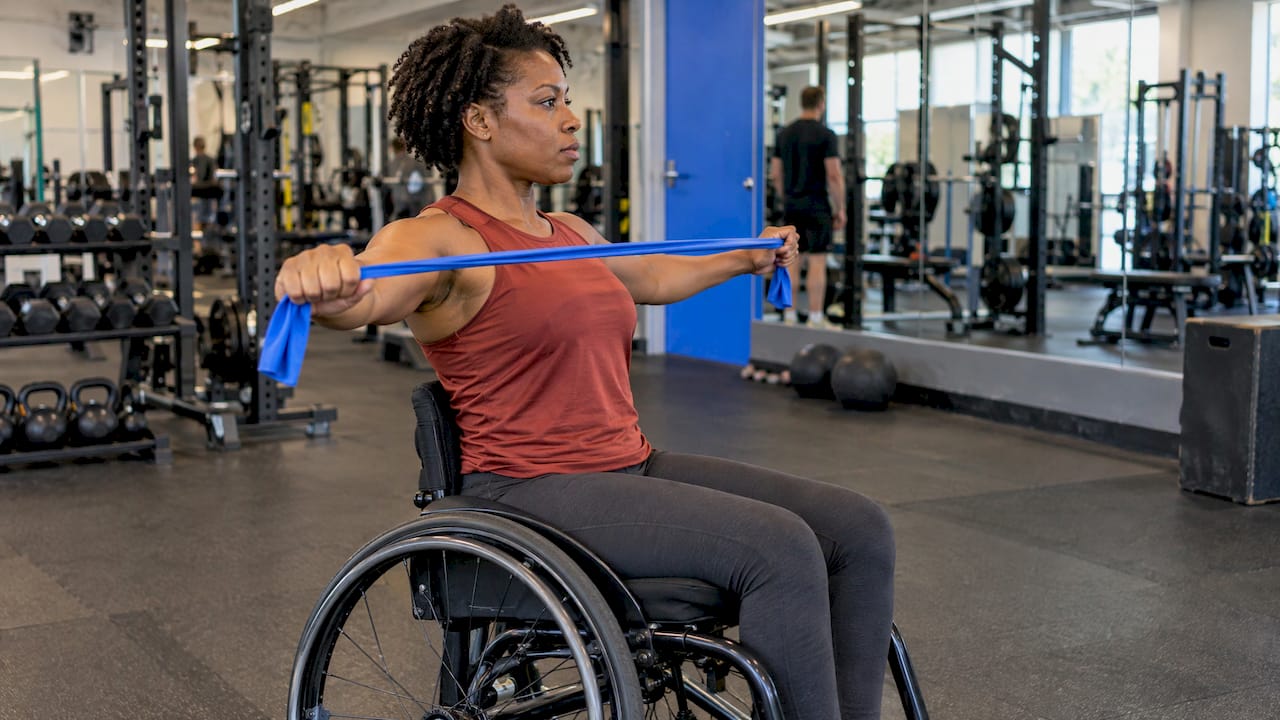
For a deeper look at the range and how people enter fitness through it, the 2024 review by Jamieson and Wijesundara sorts commercially available adaptive tools by cost, accessibility, ease of learning and progress level.
Start with the client, not the equipment
The most common mistake is choosing equipment for a diagnosis. Two people with the same condition can want completely different things from a session.
The NDIS Behaviour Support Lab’s gym tip sheet gives a good model. It tells staff to see the person, not the disability, to focus on goals and strengths, to avoid assuming someone needs help, and to ask a question like “What’s the best way I can support you today?”
A simple intake conversation
- Goals. What does the client want from training: strength, fitness, rehab, social connection, a sport?
- Preferences. What have they used before, and what did they like or dislike?
- Own equipment. Do they bring a chair, a prosthesis, a communication device or straps? How do these fit with your gear?
- Support. Do they want hands-on help, a demonstration, or to be left to it?
- Communication. How do they like instructions given? Our guide to client communication accessibility covers formats and approaches.
These are questions, not a script. The client is the expert on their own body and has usually been solving access problems for years.
When a health professional needs to be involved
Some equipment carries real manual handling or safety risk. The NDIS Quality and Safeguards Commission’s Practice Alert on hoists says people with disability should be assessed by an occupational therapist, physiotherapist or other appropriately qualified health professional before any equipment is used. It also says mobility and manual handling plans should be reviewed regularly, at least every 12 months or as advised by a health professional.
That alert is written about hoists in disability support settings. The principle carries over to a gym: if a client needs transfers, lifting or specialised positioning, ask for their therapist’s guidance and follow the plan. Our disability risk assessment guide for gyms shows how to build this into your process.
Lay out the floor so equipment is part of the gym
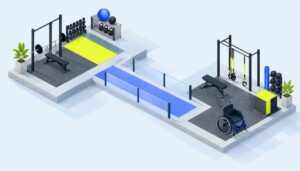
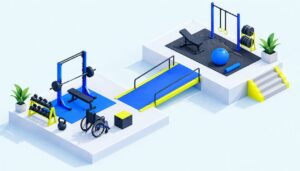
Integration is spatial. If the adaptive rower is behind a pillar and the only clear path is through the free-weights area, the equipment is technically there and practically unusable.
The NDIS BSL tip sheet recommends:
- Keeping walkways clear and spacing equipment so mobility aids can move through easily.
- Offering guided introductions for new members.
- Pointing out adaptable options such as lighter weights, straps and benches.
- Using QR codes, short how-to videos or easy-to-read signage.
Put it where everyone trains
AusActive’s Welcoming Fitness Environments report (June 2026) describes inclusive design as considering different needs from the outset, including adaptable equipment, flexible programming, inclusive communications, staff training and supportive policies. The same report notes that Anytime Fitness requires any function on an upper level to be replicable on the ground floor, and requires specific accessible equipment, such as a SkiErg and an air bike, on the ground level of all its clubs.
Take the lesson even if you run a single studio. Put the accessible options on the level and in the zone where most members train. Mixing them with standard equipment means a client can train beside a friend, and a friend can try the adaptive option too.
Remember the rest of the visit
Equipment is only useful if the client can reach it comfortably. Entry, toilets and changing spaces matter just as much, and our guide to accessible changing rooms covers that part of the journey. If your clients include people who are sensitive to noise, light or crowding, see our practical guide to sensory-friendly gym design.
Written and visual information
The Inclusion Alliance Fitness Toolkit advises that written material be simple and available in a range of formats, such as Braille, larger fonts and clear, brief text. Apply that to equipment instructions: a laminated card with large type and a QR code to a short video does more than a manual in a drawer.
Train every person who might use or explain the equipment
A single trained staff member is a single point of failure. They take leave, and the client arrives on a Saturday.
The NDIS Commission’s Practice Alert sets a useful standard for any equipment with handling risk. Workers should be trained to implement the person’s mobility and manual handling plan, in the actual environment with the person present, on the same model of equipment they will operate. Refresher training should be provided regularly.
AusActive’s report goes further on culture. It recommends making disability awareness mandatory for all team members, investing in staff training and disability confidence, creating pathways for people with disabilities to join the workforce, and building member groups that give feedback and share lived experience.
What a good training session covers
- How each piece of adaptive equipment is set up, adjusted and put away.
- How to offer help without taking over, and how to accept “no thanks”.
- Which situations need a health professional’s plan before use.
- How to talk about equipment without patronising language. Our piece on ableism in fitness shows what that looks like in practice and how to fix it.
Maintain, label and inspect
Adaptive equipment often sees heavier or more specialised use than standard gear, and a failed strap or seat is a safety problem. The NDIS Commission’s alert suggests that providers keep a schedule to make sure equipment is in good working order, consider taking photos to monitor wear over time, and label each participant’s equipment with servicing dates.
A gym version might look like this:
- A named person is responsible for adaptive equipment checks.
- Each item has a label showing its last service date.
- Staff photograph straps, seats and attachment points at set intervals to spot wear.
- Faulty gear is taken out of use and tagged straight away.
- Client feedback about discomfort or difficulty is recorded and passed on.
Check the manufacturer’s instructions for each item, since the right interval depends on the product.
Check that it is working for the client
Installing equipment is not the end of the job. Reviewing whether it works is part of integration, and it is best done with the client rather than about them.
There is no single standard test, so build a simple routine of your own:
- Ask after each of the first few sessions. Was the set-up comfortable? Did anything need constant adjusting? Would a different attachment help?
- Watch for independence. Can the client set up and use the equipment with less help over time, if that is what they want?
- Track their goals. If the aim is a 20-minute row or a heavier press, record progress the way you would for any client.
- Review on a schedule. Where a health professional’s plan exists, the NDIS Commission’s guidance is to review it at least every 12 months or as the professional advises. Many trainers choose to check in more often than that.
- Invite changes. A client’s goals, body and preferences move. Equipment that suited them in March may not suit them in September.
The design of the programme matters as much as the gear. See our guide to adaptive fitness programs for how to structure sessions that build on the equipment you have.
Australian accessibility requirements
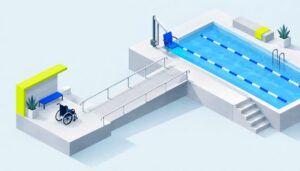
Equipment sits inside a building, and the building has obligations. Part D1 of the National Construction Code’s 2025 edition covers access and egress. It requires access, to the degree necessary, for people to approach the building from the road boundary and any accessible car parking spaces, to reach work and public spaces, to use facilities for personal hygiene, and to find accessways identified at appropriate locations.
In other words, even excellent adaptive equipment cannot compensate for an inaccessible approach or a blocked path to the training area. If you are refurbishing or unsure whether your premises comply, speak to a building certifier or accessibility consultant about your specific building.
Why we think integration needs training, not just kit
Our view
We see the same pattern in many gyms. Someone buys one adaptive machine, puts it near the back, and waits for people with disability to find it. They rarely do, and the gym concludes there is no demand.
What changes the picture is people. A trainer who can ask the right question, set up the equipment confidently and talk to a client as an adult makes the machine usable. Without that, the equipment is just furniture.
That is why our courses are practical and co-designed with people with disabilities. We built them to give fitness professionals knowledge they can use on Monday morning, without the condescending tone found in many training programs. Our courses are CPD accredited, and we think equipment decisions are far better when staff understand the social model of disability and how clients actually experience gyms.
Start with the client’s goals, bring in their health professional where the risk calls for it, put the gear on the main floor and train the whole team. That is integration.
Tommy
Build your team’s confidence
If your staff want a starting point, our free introductory crash course, Train Clients With Disability, covers the practical basics. For deeper background, The Social Model of Disability is A$40 one-off, and History of Disability in Australia is A$20 one-off. Both are in our store.
Running a gym or an institution? We offer group and team enrolment so your whole staff trains together. Visit Inclusive-AF to ask about it, or read our group training rollout plan for gyms.
FAQ
What are examples of adaptive equipment in a gym?
Common examples include adaptive rowing machines, treadmills and arm ergometers, along with mono ropes and wheelchair tension bands. Handcycles, wrist-strapped weights and Velcro mitts are also used. Apps count too: The Conversation lists fitness apps as one of four categories of adaptive fitness tools.
What is the difference between adaptive equipment and an assistive device?
Adaptive equipment is a subcategory of assistive technology. It is designed specifically for people with disabilities, or modifies an existing tool to suit the user. Assistive technology is the broader group. A wheelchair a client brings is an assistive device, while a strap or seat modified so they can use a machine is adaptive equipment.
Does a client need a health professional’s approval before using adaptive equipment?
Not for every item, but equipment with handling or safety risk should follow an assessment. The NDIS Commission advises that people with disability be assessed by a qualified health professional, such as an occupational therapist or physiotherapist, before equipment is used. When in doubt, ask the client to share their therapist’s guidance.
How often should adaptive equipment be checked?
Follow the manufacturer’s instructions for each item and keep a service schedule. The NDIS Commission suggests labelling equipment with servicing dates and taking photos to monitor wear over time. Plans that cover handling should be reviewed at least every 12 months, or sooner if a health professional advises.
Do we need expensive machines to get started?
No. Some adaptive tools are simple and low cost, such as mono ropes and tension bands, which The Conversation reported at around US$100 and US$150. Clear walkways, adjustable benches, lighter weights and trained staff make a large difference before you spend on larger machines.
Sources
- People with physical and mobility disabilities need to work out (The Conversation)
- What are adaptive technologies? (University of Wisconsin-Madison)
- What Is Adaptive Equipment (BraunAbility)
- Exercise for individuals with disabilities (NCHPAD)
- Assistive technology in sport (Wikipedia)
- A review of adaptive equipment and technology for exercise (Disability and Rehabilitation: Assistive Technology)
- Gym Tip Sheet (NDIS Behaviour Support Lab)
- Practice Alert: Safe Use of Hoists (NDIS Quality and Safeguards Commission)
- Welcoming Fitness Environments report (AusActive)
- Inclusive Fitness toolkit (Inclusion Alliance)
- NCC 2025 Part D1 Access and egress (ABCB)
- Pilates for hypermobility