A disability risk assessment for a gym is a standard risk process (identify, assess, control, review) pointed at access, communication and environmental barriers, and built with the people who face them. A generic gym safety checklist checks the equipment and the fire exits. It rarely asks whether a member who uses a wheelchair, has low vision or is autistic can get in, move around, understand the instructions and leave safely. This guide shows you how to close that gap.
TL;DR
- Use the four-step process: identify hazards and barriers, assess them, control them, then review. Disability is the lens, not a separate system.
- Consult disabled members and staff before you decide on controls. Under Australian work health and safety (WHS) guidance, consultation is part of every step.
- Assess the facts of your environment, equipment and tasks, not assumptions about what a person with a disability can or cannot do.
- Record hazards, consultation, controls and results, and review whenever something in the gym changes.
- Trained staff make the controls work. A ramp does nothing if the team does not know how to support the person using it.
Table of Contents
- What a disability-inclusive risk assessment actually is
- Why a general gym safety checklist is not enough
- Start with consultation, not a clipboard
- The four steps, applied to disability
- What to assess: a working checklist
- Controls that work in practice
- Your legal footing in Australia
- Recording and reviewing your assessment
- Build the skills behind the assessment
- FAQ
- Sources
What a disability-inclusive risk assessment actually is
The Australian fitness industry’s own risk management manual, published by AusActive, treats risk management as a cycle: identify, assess, control and review. A disability-inclusive version uses the same cycle. What changes is what you look for. You are checking access, communication and environmental needs alongside the usual slips, trips and equipment faults.
That shift matters because a standard checklist is written around an assumed “typical” member. It asks if the first aid kit is stocked and the exits are marked. Those are good questions. They do not tell you that the only accessible toilet is used as storage, that the gym map exists only as a printed poster, or that the group class room has a step at the door.
The point is not to produce a document that says disabled members are “high risk”. It is the opposite. You find the barriers in your own building and systems, and you remove or reduce them, so that members can train with the same baseline of safety as everyone else.
Why a general gym safety checklist is not enough
Templates for gym risk assessments are easy to find, and they are a fine starting point for equipment inspections, cleaning, first aid and emergency exits. They fall short in three ways.
- They ask about the equipment, not the person’s route to it. A machine can be in perfect working order and still be unreachable.
- They rarely involve the people affected. Safe Work Australia’s guidance says a business must consult workers directly affected, so far as is reasonably practicable, when identifying hazards, assessing risks or deciding on controls. A checklist completed alone by a manager skips that step.
- They treat everyone the same. The Australian Human Rights Commission explains that discrimination can be indirect: a requirement that treats everyone identically can still disadvantage people with disability, which is why reasonable adjustments matter.
Research with gym users points the same way. A well-cited qualitative review of gym use by people with disability describes themes including the perceived conflict between gym values and disability. Your risk assessment is one of the few documents that can address that perception with concrete action.
Start with consultation, not a clipboard
Before you walk the floor, talk to people. That includes disabled members, disabled staff and the trainers who work with them daily.
Safe Work Australia’s psychosocial hazards code notes that effective consultation improves decisions because workers can identify hidden risks and offer practical, often simple, solutions based on their daily experience. The same code says workers with disability should have the opportunity to take part in consultation, and that it may take different forms. In practice, that means offering more than one way to give input: a short conversation, a written form, a phone call, or an anonymous option.
Some ways to do this well:
- Ask open questions: “What makes it hard to use the gym?” rather than “What is your condition?”
- Use person-first language and ask whether participants have specific requirements, as the Inclusion Alliance fitness toolkit advises staff to do.
- Let people choose how much to share. You need to know what they need, not their medical history.
- Close the loop. Tell people what you changed, and what you could not change yet and why.
The same guidance says a duty holder must not assume others are managing a risk. If your gym leases the premises, shares a building, or uses contractors for cleaning or maintenance, agree in writing who handles which hazard.
The four steps, applied to disability
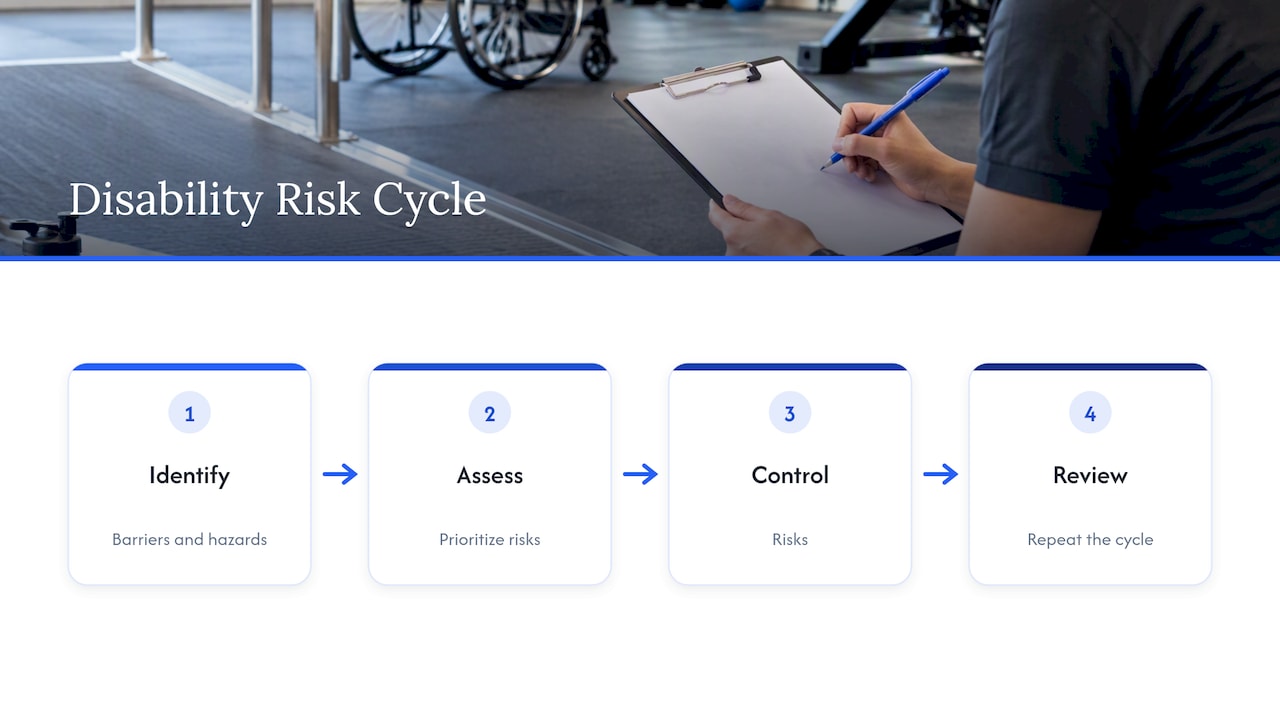
Step 1: Identify barriers and hazards
The AusActive manual lists practical methods for finding risks: activity flowcharts, internal or sector incident data, checklists, fault-finding diagrams, and focus groups, interviews or surveys. Several suit this job well.
Try a journey flowchart. Map every step a new member takes: finding your website, travelling to the gym, parking, entering, signing up, using the toilet, finding a locker, getting to the equipment, joining a class, asking for help and leaving. Then mark where each step could fail for someone with mobility, vision, hearing, cognitive, sensory or energy-related access needs. The map shows barriers a static checklist hides.
Step 2: Assess and prioritize
The manual’s approach is to rate risks by the severity of potential harm and the likelihood of it happening. Safe Work Australia’s concept of what is reasonably practicable weighs the likelihood and degree of harm against what you know or should know, and the availability and suitability of ways to eliminate or minimize the risk.
Keep this factual. Assess the environment, the equipment and the task: how wide is the aisle, how high is the cable pulley, what happens when the lights flicker or the music is loud. Do not assess “a person with a disability” in the abstract. Disability is not a single risk profile, and two people with the same diagnosis can need completely different things.
The same guidance says a formal risk assessment is not mandatory for every task, but is needed in most cases to work out what steps are reasonably practicable. For a gym open to the public, treat it as needed.
Step 3: Control
Work through the options from the most effective (removing the hazard) down to the least (relying on someone to remember a rule). A removed step beats a sign warning about it. Controls are covered in detail below.
Step 4: Review
Review before you change the workplace, when you identify a new risk, or when consultation suggests a change is needed. The AusActive manual frames this as part of the cycle, not an annual chore. A new piece of equipment, a floor layout change, a new class format or a member’s feedback each triggers a quick re-check of the affected area.
What to assess: a working checklist
Use this as a prompt list and adapt it to your site. It is built on the practical adjustments recommended by Vision Australia and a council accessibility guide for sport and active recreation.
| Area | What to check | Example control |
|---|---|---|
| Arrival and entry | Continuous path from parking or transport, door width and weight, ramps, step-free access | Fix or add a ramp, install an automatic door |
| Signage and information | Colour contrast, accessible formats including Braille and audio, an accessible online gym map | Contrasting signs, audio-described layout, online map |
| Floor and layout | Clear floors, space between equipment, overhanging equipment, hazardous spots | Remove clutter, pad overhangs, mark hazards |
| Equipment | Visibility, reach, adjustability, transfer space beside machines | Add colour to dumbbells, weight plates and cross-trainer handles |
| Toilets and changing | Accessible toilets that are free of storage and working | Regular checks, clear the space |
| Classes | Pace, instruction style, ability to modify, room access | Verbal descriptions, optional modifications |
| Sensory environment | Noise, lighting, crowding | Quieter sessions, adjustable settings |
| Emergencies | How a person will be alerted and leave or shelter safely | Individual plan agreed with the member, staff drills |
| Staff | Awareness and confidence | Training as part of onboarding |
Facilities and equipment
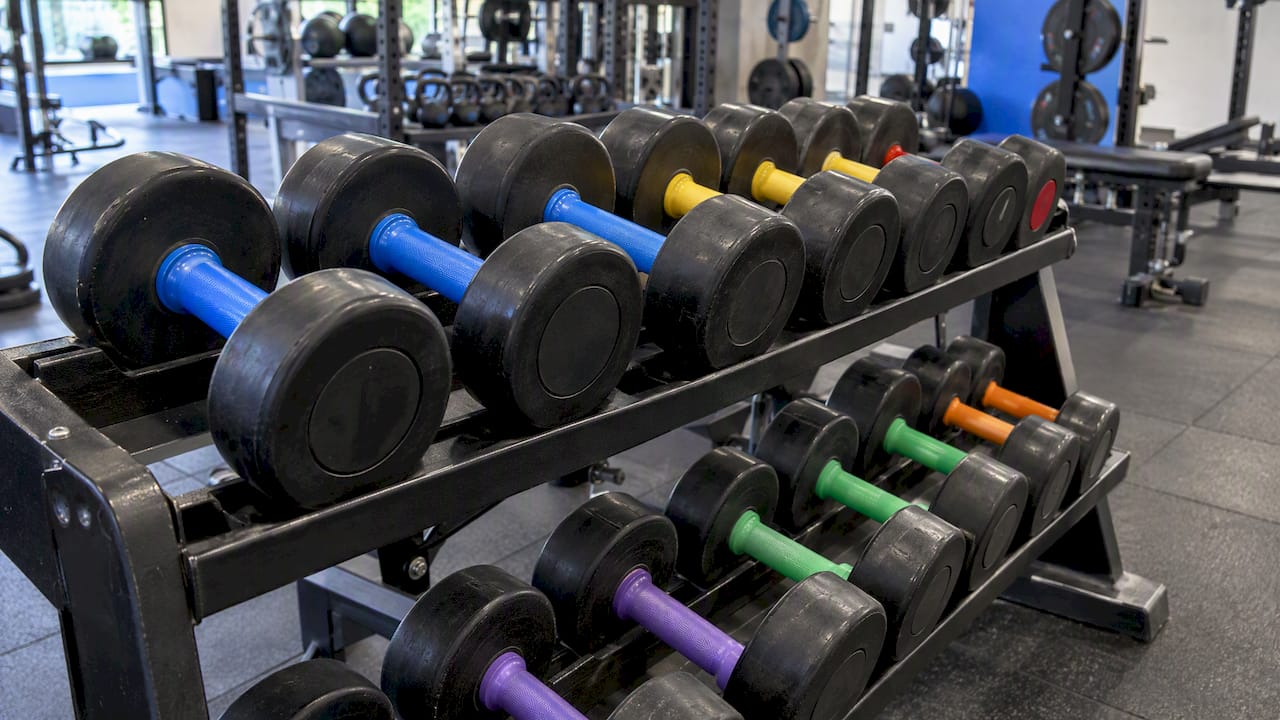
Vision Australia recommends keeping floors clear of obstacles, leaving space between equipment, padding overhanging equipment and marking hazardous spots. It also suggests adding colour to dumbbells, weight plates and cross-trainer handles, audio-describing the gym layout and providing an accessible online map. These are low-cost items, and they help many members, not only those with low vision.
The council guide adds continuous paths, colour-contrasted signage in accessible formats, accessible toilets and ramps, and disability-awareness training for staff.
For changing rooms, which are often the biggest barrier, see our guide to accessible changing rooms.
Classes and sensory environment
Class risks are often communication risks: instructions given only by demonstration, fast transitions, loud music or strobing lights. If your members include autistic people or those with sensory sensitivities, our guide to sensory-friendly gym design goes through lighting, sound and layout in practical detail, and the page on autism-friendly gyms in Australia shows what makes the approach work day to day.
Vision Australia also suggests knowing your quieter periods, because some customers with disability prefer to attend when equipment and staff assistance are easier to get. Telling members when those times are is a small control with a real effect.
Emergency procedures
Emergency planning is the area where a generic checklist is least likely to help. Marked exits are not enough if a member cannot hear the alarm, cannot see the exit sign, or cannot use stairs. Ask each member who wants a plan how they would like to be alerted and assisted, record it with their agreement, and make sure the staff on shift know it. Check your current obligations for building evacuation with your local authority and your fire safety adviser, since requirements vary between states and territories.
Individual health conditions
Some risks are specific to how a person’s body responds to exercise, and those are not for a manager to guess. When a member has a condition such as a spinal cord injury or a connective tissue disorder, ask the member and, where they agree, their health professional what is relevant. Our practical guides on training clients with spinal cord injury and Ehlers-Danlos exercise show how trainers approach this without making assumptions.
Controls that work in practice
Good controls share a few features: they are specific, someone owns them, and they do not rely on the disabled member working around the gym.
- Remove the barrier. Clear the path, fix the ramp, relocate the stored items.
- Change the environment. Add contrast and colour, pad overhangs, reduce noise at set times.
- Change the process. Offer an optional orientation, give instructions in more than one format, make sign-up forms ask “What would help you?”
- Train the people. Staff who are confident, ask rather than assume, and know the emergency steps turn a physical adjustment into a good experience.
- Agree individual adjustments. Write down what the member and the gym have agreed, and who on the team needs to know.
On language, keep it plain and respectful. Much of the poor experience reported by disabled gym-goers comes from patronizing attitudes, not from the equipment. If you want to audit that side of your culture, our article on ableism in fitness lists what it looks like and how to fix it.
Your legal footing in Australia
Two frameworks sit behind this work. WHS law requires you to eliminate or minimize risks so far as is reasonably practicable, and to consult those affected. Disability discrimination law, which the Australian Human Rights Commission explains in its accessibility guidance for businesses, requires reasonable adjustments and recognizes that identical treatment can still disadvantage people.
WHS is administered state by state, and the details of regulators, building codes and local planning rules differ between jurisdictions. Before you act on a major build change, check with your state or territory WHS regulator and a qualified access consultant. This article is a practical guide, not legal advice.
Recording and reviewing your assessment
A record that no one can find helps no one. Keep one document, or one shared folder, that shows the four steps:
- Hazards and barriers identified, with the method used (walk-through, journey map, incident data, member survey).
- Consultation notes: who you asked, when, how, and what they said.
- Risk ratings and the reasoning behind your priorities.
- Controls with an owner and a target completion time.
- Effectiveness checks: did the control work, and how do you know?
- Review triggers: planned changes, new risks, feedback that suggests a change.
This matches what AusActive and Vision Australia describe as the documentation of the full process. Keep entries short and dated. Treat every member complaint or near miss as data for the next review, and share outcomes with the staff who deliver the service.
Our view: the checklist is the easy part
We built Inclusive-AF because most gym risk assessments stop at the equipment. In our experience, the hard part is the human side: asking the right question, listening to the answer, and not being condescending while you do it. Our courses are co-designed with people with disabilities, which is why they focus on practical skills rather than pity.
A risk assessment only works if the people running it understand how disabled people actually experience a gym. That is what our modules teach, from the social model of disability to hands-on guidance for training clients. All of our courses are CPD accredited.
If you do one thing this month, sit down with a disabled member and walk the gym together. You will learn more in twenty minutes than from any template.
Tommy
Build the skills behind the assessment
A risk assessment tells you what to fix. Your team still needs the knowledge to act on it. Our Crash Course: Train Clients With Disability gives trainers a practical start, and The Social Model of Disability ($40 AUD, one-off) explains why barriers sit in environments and systems, which is the logic of any good assessment. History of Disability in Australia costs $20 AUD one-off. You can browse everything on our course store, and we offer a free introductory course so you can try our approach first.
Running a team or a whole site? Ask us about group and team enrolment, or see our plan for a group training rollout for gyms.
FAQ
Is a disability risk assessment legally required for a gym?
Gyms must manage risks so far as is reasonably practicable and consult those affected, and a formal risk assessment is needed in most cases to work out what that means. Disability discrimination law adds a duty of reasonable adjustments. Requirements vary by state and territory, so check with your WHS regulator.
How often should we review it?
Review before you change the workplace, when you spot a new risk, and when consultation suggests a change. Equipment moves, new classes and member feedback are all triggers. Many gyms also set a regular review date so nothing is missed.
Do we need to know a member’s diagnosis?
No. You need to know what helps them train safely, such as how they would like to be alerted in an emergency or whether they need space beside a machine. Ask open questions, let the member decide what to share, and treat what they tell you as private.
What are the cheapest changes to make first?
Clear floors, leave space between equipment, pad overhanging equipment, mark hazardous spots and add colour to weights and handles are all low-cost, per Vision Australia. Publishing an accessible online gym map and telling members your quieter times also cost little.
Who should be involved in the assessment?
Managers, trainers, front-desk staff and, most importantly, disabled members and staff. Safe Work Australia’s guidance says consultation helps surface hidden risks, and that duty holders should coordinate rather than assume someone else has it covered.
Sources
- The Australian Fitness Industry Risk Management Manual (AusActive)
- Creating a more inclusive gym (Vision Australia)
- How to determine what is reasonably practicable (Safe Work Australia)
- Managing psychosocial hazards at work (Safe Work Australia)
- Inclusive Fitness toolkit (Inclusion Alliance)
- Accessible and Inclusive Sport and Active Recreation
- Access for all: Improving accessibility for consumers with disability (Australian Human Rights Commission)
- Richardson et al., barriers and facilitators of gym use for people with disability