If your gym or training business delivers supports to NDIS participants, safeguarding is a legal duty, not a nice extra. The NDIS Code of Conduct applies to registered and unregistered providers and their workers. It requires them to take all reasonable steps to prevent and respond to violence, exploitation, neglect, abuse and sexual misconduct. If you simply have members who happen to be on the NDIS, good safeguarding habits still protect them and you. This guide covers who is covered, what you must report, and the practical systems that make safeguarding routine.
TL;DR
- The NDIS Code of Conduct covers registered and unregistered providers and their workers, so a gym delivering NDIS supports is covered even without registration.
- Registered providers must report serious incidents, such as abuse, neglect or serious injury, to the NDIS Commission within 24 hours of becoming aware.
- Safeguarding in a gym comes down to written policies, trained staff, accessible communication, consent and privacy practices, and a complaints pathway people can actually use.
- If staff suspect a crime or someone needs urgent medical care, call 000 first, then follow your incident process.
- NDIS funding for gym memberships and personal training is restricted, which is separate from your safeguarding obligations.
Table of Contents
- What safeguarding means in a gym
- Who the NDIS rules apply to
- Reportable incidents: what to notify and when
- Practical safeguards that work on a gym floor
- Worker screening and who needs it
- Funding is a separate question
- A starter safeguarding checklist for your gym
- Build your team’s skills with Inclusive-AF
- FAQ
- Sources
What safeguarding means in a gym
The NDIA’s Participant Safeguarding Policy describes safety as people being safe from violence, abuse, neglect and exploitation. Safeguards are the actions and measures that respond to risk and protect people from those harms. The policy also recognises two kinds. Informal safeguards are family, friends, neighbours and community. Formal safeguards are organisational policies, processes and behaviours that help staff respond appropriately.
A gym is mostly a formal safeguard. You control the environment, the staff, the way sessions run and what happens when something goes wrong. That includes the things people rarely call safeguarding but should:
- A trainer who is alone with a client in a closed studio.
- A changing room that is not accessible, which pushes a client to rely on someone else for personal care.
- A client who cannot easily tell staff something is wrong because communication was never set up in a way that works for them.
- A complaint that goes nowhere because the only channel is a front-desk conversation.
Safeguarding is also not the same as wrapping people in cotton wool. The same NDIA policy acknowledges dignity of risk: exploring new opportunities and extending a person’s choice. It says the right of people with disability to express their will and preference is respected. Good gym safeguarding supports ambitious training goals and manages the risk around them. It does not talk a client out of them.
Who the NDIS rules apply to
The NDIS Commission’s Code of Conduct page lists who is covered: registered providers, their key personnel and workers, and unregistered providers, their key personnel and workers. It also covers providers delivering information, linkages and capacity building activities. The Code sits under the National Disability Insurance Scheme (Code of Conduct) Rules 2018.
The practical reading for a gym:
| Your situation | What it likely means |
|---|---|
| You are a registered NDIS provider | The Code of Conduct, the Practice Standards and reportable incident rules all apply |
| You deliver NDIS-funded supports but are not registered | The Code of Conduct still applies to you and your workers |
| You run a general gym and members use their own money | Not an NDIS obligation as such, but the same practices protect members and your business |
If you are unsure which row you sit in, ask the NDIS Commission directly. Do not assume that being unregistered means you are outside the rules.
What the Code of Conduct asks of you
The Code requires providers and workers to take all reasonable steps to prevent and respond to all forms of violence against, and exploitation, neglect and abuse of, people with disability. It also requires reasonable steps to prevent and respond to sexual misconduct. The Code of Conduct Provider Guidance sets out what that looks like in practice. Providers should:
- Have policies, systems and procedures designed to increase understanding of, and eliminate, violence, abuse, neglect and exploitation.
- Make sure workers understand and use those policies.
- Encourage workers to use their own initiative to notice situations that could lead to harm and step in early.
- Use incidents and responses to improve how they work.
- Tell people with disability and workers about every avenue for raising concerns or complaints.
- Uphold whistleblower protections.
That list is a good skeleton for a gym policy pack. Turn each line into a document, a training session and a check you repeat.
Reportable incidents: what to notify and when
The NDIS Act 2013 defines reportable incidents. As set out in the Provider Guidance, they are:
- The death of a person with disability.
- Serious injury of a person with disability.
- Abuse or neglect of a person with disability.
- Unlawful sexual or physical contact with, or assault of, a person with disability.
- Sexual misconduct committed against, or in the presence of, a person with disability, including grooming.
- Use of a restrictive practice, other than where it is in accordance with a State or Territory authorisation.
On timing, the NDIS Commission’s reportable incidents page says registered providers must notify within 24 hours of becoming aware of death, serious injury, abuse or neglect, unlawful sexual or physical contact or assault, and sexual misconduct. An unauthorised use of a restrictive practice must be notified within 5 business days, or within 24 hours if it caused harm.
For a gym, “serious injury” is the one most likely to come up. A fall from a bench, a transfer that goes wrong, a seizure during a class: you need to know in advance who decides whether it is reportable and who makes the call to the Commission. Do not work that out after the event.
What a trainer does in the moment
The NDIS Commission’s practice guide for workers is clear and simple enough to put on a staff-room wall:
- If someone needs immediate medical care or you suspect a criminal offence, call 000 and do not delay.
- Tell your supervisor, a member of key personnel, or whoever your incident system names as responsible for reporting, as soon as possible.
- Write down what the affected person told you, in their exact words where possible.
- Record witnesses, what you saw and any action you took.
- Leave out your opinions and interpretations.
Rehearse this. A team that has walked through it once handles the real thing far better than one that has only read the policy.
Practical safeguards that work on a gym floor
The Commission’s Practice Alert on bullying says providers should show that policies and practices actively prevent violence, abuse, neglect, exploitation or discrimination. It also expects that allegations and incidents are acted on, affected participants are supported, records are kept of reviews and outcomes, and action is taken to prevent a repeat. Here is how that translates to a gym.
Set up the environment
The Core Module on Provision of Supports Environment expects, among other things, that:
- Participants can easily identify the workers who support them.
- Supports are delivered in settings that are safe.
- There are clear arrangements for participants who need communication support.
- Protocols exist for medical emergencies, and each worker is trained to respond.
- Systems for escalating urgent health situations are in place.
In gym terms: name badges or uniforms, a layout where sessions are visible, an emergency plan that has been practised, and first aid skills that are current. A disability risk assessment for your gym is a sensible way to find the hazards in your space before an incident does. Changing rooms are a common weak point; our guide to accessible changing rooms covers what to fix.
Get consent, privacy and choice right
The Core Module on Rights and Responsibilities asks that each participant:
- Is told about confidentiality policies in the language, mode of communication and terms they are most likely to understand.
- Understands and agrees to what personal information is collected and why.
- Is supported in active decision-making and individual choice.
- Has their right to dignity of risk supported.
- Can access an advocate of their choosing.
For a trainer this means an intake process in plain language, with options such as easy-read, visual or spoken formats. It means asking before any hands-on assistance, every time, and recording what the client agreed to. If a client brings a support person or advocate, welcome them into the conversation without talking over the client. Our guide to client communication accessibility goes through the formats in detail.
Build a complaints pathway people will use
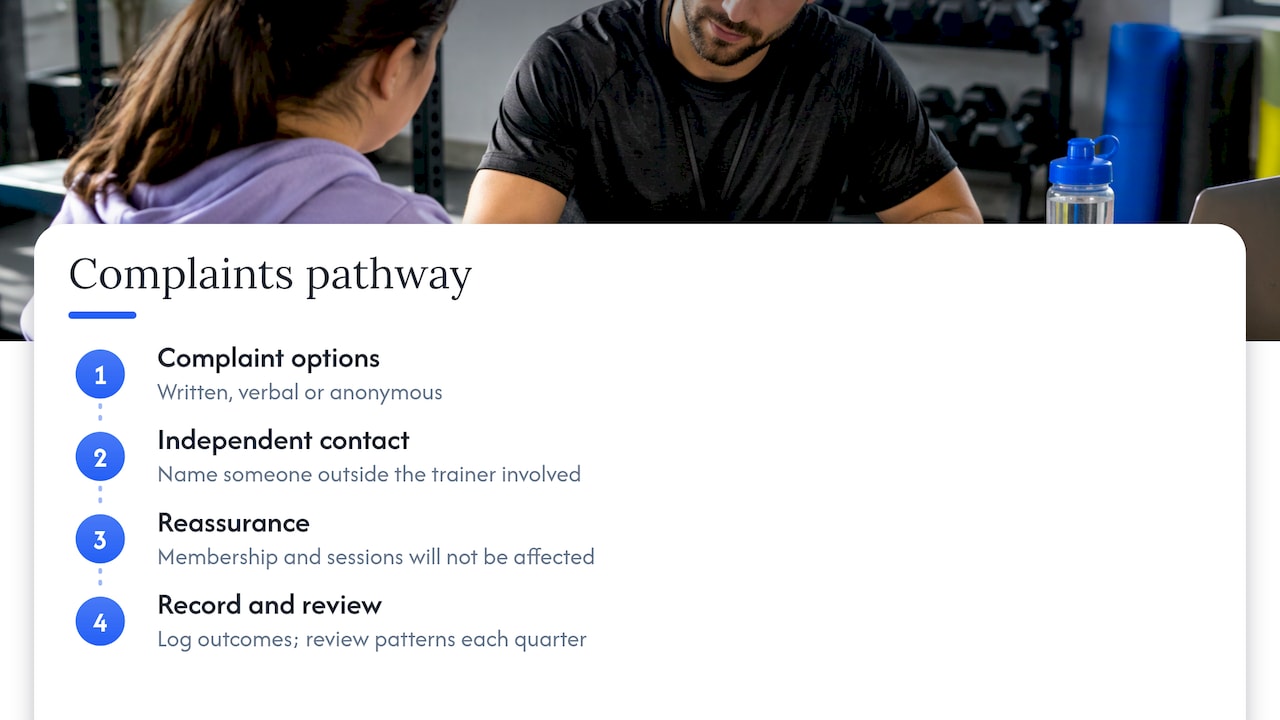
The Provider Guidance expects you to tell people about every avenue for raising concerns. In a gym, that means more than a poster. Offer written, verbal and anonymous options. Name someone who is not the trainer involved. Explain that raising a concern will not affect their membership or sessions. Keep a record of each complaint and the outcome, and review the pattern each quarter.
Train the whole team
Policies are only as good as the people applying them. The Practice Alert on bullying says that providers should set clear expectations about values, attitudes and behaviours, model them consistently, and back them with supervision, training and support. Reception staff, cleaners and casual instructors count as well as head trainers. Our ableism in fitness guide helps teams spot the everyday behaviours that wear down trust, and the disability inclusion basics page is a sound starting point for new staff.
For wider grounding in abuse prevention, participant rights and worker responsibilities, safeguarding and care CPD courses can add background for staff who want formal learning on those topics.
Worker screening and who needs it
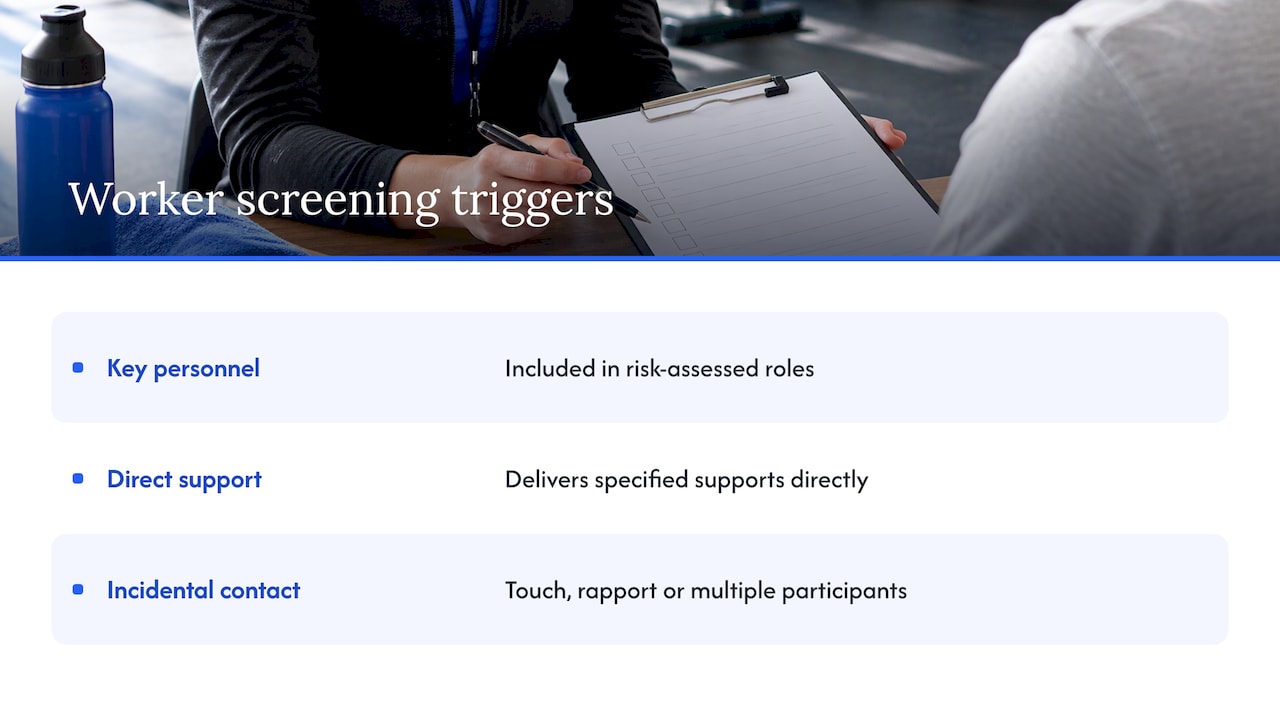
Screening is set by the states and territories, so check with yours. The Victorian Government’s NDIS Worker Screening Check page describes a risk-assessed role as including a key personnel role, a role whose normal duties include directly delivering specified supports to a person with disability, and a role likely to involve more than incidental contact with people with disability. More than incidental contact includes physically touching a person with disability, building rapport as an integral part of the duties, or contact with multiple people with disability.
A personal trainer who spots, adjusts positions and works one-on-one with participants fits that description closely. Treat it as a question to settle with your state’s screening unit before a trainer starts, not after.
Funding is a separate question
Owners often mix up two issues: whether the NDIS pays for a gym, and whether the NDIS rules apply to you. They are independent. On funding, the NDIA’s therapy supports page says the NDIS cannot fund gymnasium or swimming pool memberships, personal training, or social group programs that include strategies described as therapy, even when the provider is an allied health professional. Our page on what the NDIS funds and what it doesn’t in gyms explains how participants and providers can approach it.
What funding looks like for a participant does not change what you owe them. If you deliver NDIS supports, the safeguarding duties apply from the first session.
A starter safeguarding checklist for your gym
| Area | What to have in place |
|---|---|
| Policy | Written abuse, neglect and exploitation prevention policy that staff have read and signed |
| Incidents | Named person responsible for reporting, a 24-hour process, and a template that records exact words |
| Emergencies | Practised medical emergency plan and an escalation path for urgent health situations |
| Consent | Plain-language intake, consent before any physical assistance, recorded choices |
| Privacy | Confidentiality explained in a format the client understands |
| Complaints | More than one way to complain, a named independent contact, outcomes recorded |
| Screening | Role-by-role check of who needs NDIS worker screening in your state |
| Training | Induction for every worker, refreshed regularly, including front-of-house staff |
Our view
Most safeguarding training for fitness staff is written by people who have never been the client. It leans on pity, treats disabled people as fragile and teaches trainers to be nervous. We think that makes gyms less safe, because nervous staff avoid conversations and clients stop speaking up.
We build our courses with people with disability and teach practical skills: how to ask what someone needs, how to set up communication that works, how to record an incident properly and how to respect dignity of risk without ignoring real hazards. Our courses are CPD accredited and validated for industry requirements.
If you want your team to feel confident rather than anxious, start with knowledge that comes from real experience. Safeguarding then stops being a fear and becomes how you work.
Tommy
Build your team’s skills with Inclusive-AF
Safeguarding policies work when staff understand the people they are written for. Inclusive-AF offers online training for fitness professionals, gym owners and institutions. You can start with our free introductory crash course on training clients with disability, then add modules such as The Social Model of Disability ($40) or History of Disability in Australia ($20) from our store. Teams can enrol together through group and team enrolment.
If you are planning a whole-team rollout, our group training rollout plan shows how to stage it.
FAQ
Does a gym need to be NDIS registered to follow the Code of Conduct?
No. The NDIS Commission says the Code applies to unregistered providers, their key personnel and workers as well as registered ones. If you deliver NDIS supports, you are covered whether or not you are registered. If you are unsure about your status, contact the NDIS Commission.
What should a trainer do if a client discloses abuse?
If the person needs urgent medical care or you suspect a crime, call 000 first. Then tell your supervisor or the person named in your incident system as soon as possible. Write down what the client said in their own words, plus witnesses and what you saw, and leave out your opinions.
How quickly must serious incidents be reported?
Registered providers must notify the NDIS Commission within 24 hours of becoming aware of a death, serious injury, abuse, neglect, unlawful sexual or physical contact, assault or sexual misconduct. Unauthorised restrictive practices have a 5 business day window, or 24 hours if harm resulted.
Can NDIS funds pay for a gym membership?
The NDIA states that the NDIS cannot fund gymnasium or swimming pool memberships or personal training as therapy supports. Participants should check their plan and the NDIA’s guidance, or speak to their planner or support coordinator.
Sources
- NDIS Code of Conduct, NDIS Commission
- National Disability Insurance Scheme (Code of Conduct) Rules 2018
- Participant Safeguarding Policy, NDIA
- Code of Conduct Provider Guidance, NDIS Commission
- Reportable incidents, NDIS Commission
- Practice guide for workers on incidents, NDIS Commission
- Practice Alert on bullying in disability services, NDIS Commission
- Core module: Provision of supports environment
- Core module: Rights and responsibilities
- NDIS Worker Screening Check, Victorian Government
- What are therapy supports, NDIS