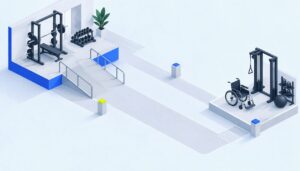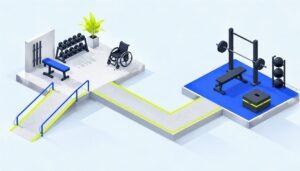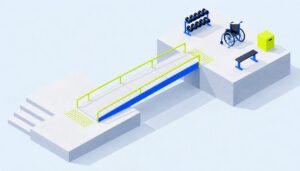

Inclusive fitness marketing means your promotion, website, imagery and enquiry process show disabled people and other under-served groups that they are welcome, and that your staff and facility can deliver on it. In Australia, the industry body describes inclusion as something built into the whole customer journey: before, during and after a visit. A campaign alone is not enough. The message has to be true on the gym floor.
This guide covers what that looks like in practice, what Australian gyms have done, the legal ground you stand on, and a step-by-step way to check your own marketing.
TL;DR
- Inclusive marketing is a promise about the whole member journey, so the website, the enquiry process, the facility and the staff training must match what the ads say.
- Show real members, co-design with disabled people, and put them in mainstream campaigns rather than in a separate “disability” corner.
- Treat web accessibility and plain, visible support options as part of your marketing, not an afterthought. Australian disability discrimination law covers services and facilities.
- Audit before you advertise: walk the journey with disabled people, fix what you find, then make claims you can keep.
- Staff training is what turns an inclusive message into an inclusive experience.
Table of Contents
- What inclusive fitness marketing means in Australia
- Examples from Australian gyms
- Represent people authentically
- Make the marketing itself accessible
- The legal ground in Australia
- An inclusion audit before the campaign
- Build the offer your marketing promises
- Where our training fits
- Measure and keep improving
- FAQ
- Sources
What inclusive fitness marketing means in Australia
Most gym marketing speaks to one imagined member: young, able-bodied, motivated by a transformation. Inclusive marketing widens that picture. It covers disability (physical, sensory, intellectual, psychosocial, neurodivergent), but also age, body size, gender, culture and faith.
AUSactive’s June 2026 report on welcoming fitness environments frames it as accessibility, staff education, lived experience and inclusive communications working together. The same report notes that inclusive marketing delivers commercial and reputational value through more members, better retention and stronger community ties. AUSactive’s own trend reading for 2026 points to a clear shift towards holistic health and inclusivity.
The practical consequence: a gym that posts one photo of a wheelchair user and nothing else has done decoration, not marketing. A gym that can answer “Can I bring a support worker?”, “Is there a quiet time?” and “Which classes can be adapted?” on its website has done the real work.
Examples from Australian gyms
Two examples from the research show different parts of the job.
Campaign plus capability. Anytime Fitness Australia’s “Any body, Any time” campaign challenged stereotypes of who a gym-goer is by showing people with different needs. The same announcement says the brand worked with WeFlex on an accessibility audit and on educating and certifying staff to train people with unique sensory needs and disabilities. The lesson is the pairing: the message came with an audit and training behind it.
Mainstream, not siloed. According to the AUSactive report, Belgravia Leisure put high-contrast typography, respectful imagery and models with disabilities into its mainstream national campaigns instead of keeping disability content in a separate stream. Readers with a disability are also readers of your general campaign. If they only see themselves on one special page, the message is “you are an exception”.
Represent people authentically
The AUSactive report advises co-designing campaigns with people with disabilities, using authentic local imagery of members using your facilities, and avoiding siloed disability content. Here is what that means day to day.
Use real members, with consent
Stock photos of a smiling athlete in a racing chair do not tell a local reader that your gym works for them. Photograph members in your own space, using your own equipment. Get written consent, and let people choose how they are described.
Pay and credit the people who shape it
Co-design is not a feedback survey after the creative is done. Bring disabled members, advocates or consultants in at the brief stage, and pay them for their time. They will catch the problems your team cannot see: the “overcoming” framing, the staged pity shot, the ramp that is in the photo but not on the route from the car park.
Drop the inspiration angle
A disabled person training is not inspirational by default, and “no excuses” slogans land badly with people whose barriers are structural. Describe what you offer (adapted equipment, trained staff, quiet hours) and let members speak for themselves. We go deeper on this in our piece on ableism in fitness and how to fix it.
Check the words
Plain language beats clever copy. Say “step-free entry”, “accessible changing room with ceiling hoist” or “low-sensory sessions” only when they are true, and say them specifically. Vague phrases such as “all abilities welcome” tell a reader nothing about whether they can get in the door.
Make the marketing itself accessible
A campaign that disabled people cannot read, open or respond to defeats itself. The AUSactive report recommends that gyms provide a clear website accessibility page, make requests for support simple and visible, and offer adaptations to existing classes or adapted equipment.
A working checklist:
- Website basics. Alt text on images, captions on video, sufficient colour contrast, keyboard navigation and readable text sizes. Test with a screen reader at least once.
- An access page. Describe parking, entry, lifts, changing rooms, toilets, equipment, class adaptations and how to ask for support. Link it from the footer and the booking flow.
- Multiple ways to ask. Phone, text, email and a web form. Not everyone can call, and not everyone can type. A system that handles enquiries and bookings across channels, such as an AI receptionist for appointments, can help make sure no question goes unanswered after hours, as long as a human can take over when needed.
- Accessible documents. The City of Sydney’s event guidelines advise avoiding PDF invitations in digital promotion. Put the information on the page itself, in plain text.
- Social posts. Add image descriptions, capitalise each word in hashtags, and avoid text baked into images.
The legal ground in Australia
Inclusive marketing sits on top of legal duties, not instead of them. Under section 24 of the Disability Discrimination Act 1992, it is unlawful to discriminate against a person on the ground of disability when providing goods or services, or making facilities available, whether or not payment is involved. The Australian Human Rights Commission treats websites as part of that picture and, in its guidance, recommends businesses aim for AA-level conformance with the Web Content Accessibility Guidelines. It has also published an updated guideline on equal access to digital goods and services, which replaces its earlier web advisory note.
What this means for your marketing:
- Your website, booking system and promotional channels are part of the service you provide.
- An inclusion claim you cannot support also creates a trust problem. Members who arrive to find no accessible changing room will not stay quiet about it.
- For advice on your specific obligations, such as unjustifiable hardship or your lease, speak to a lawyer or contact the Commission directly.
An inclusion audit before the campaign
The AUSactive report recommends that fitness professionals evaluate inclusivity by auditing their venues and involving people with disabilities. Do this before you write a single ad.
| Journey stage | What to check | Who to involve |
|---|---|---|
| Discovery | Website access, imagery, language, social media | Disabled members or consultants |
| Enquiry | Ways to contact, response time, staff scripts | Front-of-house team |
| Arrival | Parking, entry, signage, lighting, noise | Members with mobility, vision, sensory needs |
| Facility | Changing rooms, toilets, equipment, floor space | Access consultant, members |
| Session | Class adaptations, instructor skills, communication | Trainers, participants |
| Follow-up | Feedback channels, renewal communications | Members |
The facility stage tends to expose the biggest gaps. Our guides to accessible changing rooms, sensory-friendly gym design and autism-friendly gyms cover what to look for.
After the audit, rank the findings: quick fixes (a clearer access page, a quiet-hour timetable), medium projects (adapted equipment, class changes) and long-term works (building changes). Market what is already in place now, and publish the rest as a roadmap you update honestly.
Build the offer your marketing promises
The message and the product have to line up. Two areas matter most.
Programs that exist
If you say you support people with disabilities, there should be a named program or a clear way to adapt your classes. Our guide to designing adaptive fitness programs covers structure, and our group training rollout plan shows how to introduce inclusive sessions in stages.
Staff who can deliver

Trainers are the part of your marketing that members actually meet. They need practical knowledge of conditions they may see, such as spinal cord injury, cerebral palsy and stroke, and the confidence to ask clients what they need rather than assume.
There is precedent for structured organisational change in this country. In late 2019, Fitness Australia signed an MOU with IHRSA and the UNESCO Chair to facilitate UFIT, an evidence-based program that helps fitness businesses change how they connect with and serve people with disabilities.
Our perspective
We built Inclusive-AF because most disability training for fitness professionals talks down to the people it claims to help. Gyms then repeat the same tone in their marketing: inspiration stories, pity, vague promises.
Our view is simple. Marketing is the last step, not the first. Train your people, learn from the lived experience of disabled clients, then say plainly what you can do. Our courses are co-designed with people with disabilities, are CPD accredited and are built around practical skills, because a trainer who knows what to do will do more for your reputation than any slogan.
If you are unsure where to start, begin with the basics of how disability is understood. The social model of disability changes how you write every line of copy, because it puts the barrier in the environment, not the person.
Tommy
Where our training fits
If your audit shows that staff do not yet have the skills to back up an inclusive message, our online modules are built for that gap. The free introductory crash course, Train Clients With Disability, is a no-risk way to start. The Social Model of Disability is $40 AUD one-off, and History of Disability in Australia is $20 AUD one-off. Both are in our store. Gym owners and institutions can ask about group and team enrolment through our website.
All our courses are CPD accredited, so they count towards professional development as well as supporting your marketing claims.
Measure and keep improving
Inclusive marketing is not a one-off campaign. Track a few things:
- Enquiries that mention access, support or a specific adaptation.
- Membership and retention among members who use adapted sessions or access features.
- Feedback from disabled members, collected in more than one format.
- Staff confidence, through a short check after training.
The AUSactive report ties inclusive marketing to membership growth and retention, so these numbers are worth watching in your own business. Review them each quarter, and update your access page whenever something changes.
FAQ
What is an example of inclusive fitness marketing?
Anytime Fitness Australia’s “Any body, Any time” campaign showed people with a range of needs rather than the usual stereotype, and the brand backed it with an accessibility audit and staff certification. Belgravia Leisure also placed models with disabilities in its mainstream national campaigns instead of a separate stream.
What is inclusive marketing for a gym?
It is promotion that reflects the real range of people who can use your gym and removes barriers from how they find you, contact you and join. It includes imagery, language, accessible web content, simple ways to request support and trained staff. The marketing is only as inclusive as the experience behind it.
Do Australian gyms have legal duties on accessibility?
Yes. The Disability Discrimination Act 1992 makes it unlawful to discriminate on the ground of disability in providing services or making facilities available, and the Australian Human Rights Commission applies this to digital services too. For your specific situation, get legal advice or contact the Commission.
How do I start if my gym has no inclusive program yet?
Begin with an audit that involves disabled people, publish an honest access page, and train your staff. Only then build campaigns around what you can already deliver. Our free crash course is a practical first step for trainers.
Sources
- Welcoming Fitness Environments full report, AUSactive (June 2026)
- Fitness for all generations remains a top priority, AUSactive
- Anytime Fitness and Performics Mercerbell launch campaign celebrating individuality and inclusivity
- Inclusive and Accessible Event Guidelines, City of Sydney
- Fitness Australia 2019-2020 Annual Report
- Disability Discrimination Act 1992, section 24, AustLII
- Improving accessibility for consumers with disability, Australian Human Rights Commission
- Guidelines for equal access to digital goods and services, Australian Human Rights Commission