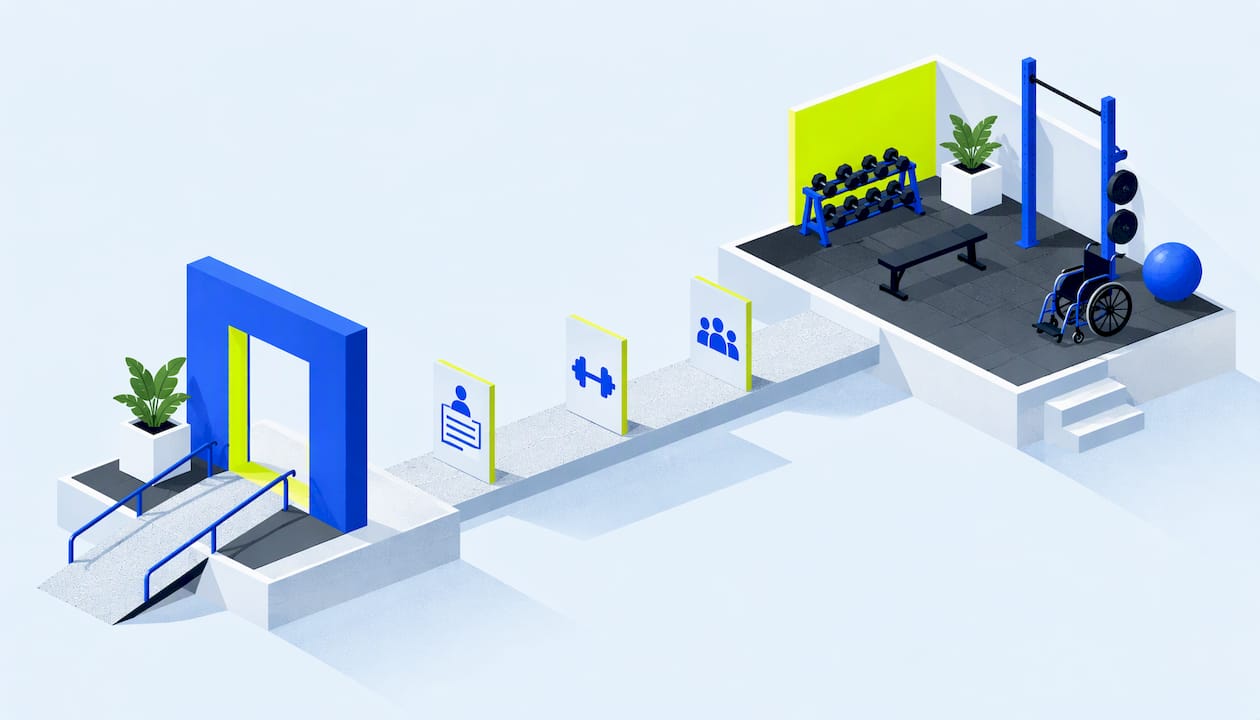
Inclusive hiring in a gym means fixing the points where disabled candidates get screened out: the job ad, the application, the interview and the first month on the floor. Your team then needs the skills and the culture to keep the people you hire. Most of the fixes cost little. The hard part is the knowledge behind them, which is why we build our courses around it. Our free introductory crash course is a good first step for a team that wants to start.
This guide covers the full hiring path for Australian gym owners, managers and fitness professionals, with the legal baseline, the practical steps and the funding that exists to help.
TL;DR
- Discriminating against a job applicant because of disability is unlawful in Australia, and that covers how you advertise, shortlist and interview, not only the final decision.
- Start with the job design: list only the essential requirements of the role, because vague or inflated criteria are where bias gets in.
- Make ads, forms and interviews accessible, invite adjustment requests from every candidate, and name a real contact person.
- Adjustments are your obligation, but government funding such as the Employment Assistance Fund can cover some workplace modifications and equipment.
- Hiring is half the job. A team trained in disability inclusion keeps the staff and members you attract.
Table of Contents
- What inclusive hiring means for a gym
- The legal baseline in plain words
- Step 1: Design the job before you advertise it
- Step 2: Make the ad and the application accessible
- Step 3: Interview and assess fairly
- Step 4: Provide reasonable adjustments, and know what funding exists
- Step 5: Onboard so people stay
- Step 6: Train the whole team, not just the new hire
- A practical checklist for gym owners
- Our perspective
- Where to start with Inclusive-AF
- FAQ
- Sources
What inclusive hiring means for a gym
Diversity Council Australia describes inclusive recruitment as hiring practices that value diversity, minimise bias and let you source, assess, select and appoint a wide range of talent, from writing the job description through to onboarding. It is a whole process, not a single policy.
The Department of Employment and Workplace Relations says that inclusive recruitment can widen both the quality and the size of your applicant pool. In a gym that matters. Personal trainers, instructors, front-desk staff and coaches are hard to find and hard to keep, and a large share of qualified people never apply to workplaces that look closed to them.
There is also a business case. business.gov.au notes that employees with disability tend to take fewer days off, stay in jobs longer and have fewer compensation incidents, and that it is illegal to discriminate against job seekers because of physical or mental disability. The same page backs the point about workplace morale.
For a gym there is a second benefit. Members with disability are more likely to join and stay when they see staff who understand their reality. A team that includes people with lived experience of disability brings knowledge no manual can copy.
The legal baseline in plain words
The Disability Discrimination Act 1992 (Cth) makes it unlawful to discriminate on the ground of disability in the arrangements for deciding who is offered a job, in the decision itself, and in the terms on which a job is offered. Two points follow for gym managers.
First, the law reaches your process. An inaccessible application form or an interview room up a flight of stairs can be a problem before anyone has judged a candidate’s ability.
Second, there is an exception for inherent requirements. Section 21A allows an employer to decline a person who could not carry out the inherent requirements of the work even with reasonable adjustments. The word that does the work is “inherent”. A personal trainer role may inherently require designing and coaching sessions. It does not inherently require demonstrating every exercise personally, unless you can show that it does. Write down what the role truly needs, and you protect both the candidate and your business.
JobAccess states that if you know an employee has a disability, you must by law provide the reasonable adjustments they need in the interview process and in the job. The law also requires equal access to recruitment, promotion and training, and equal terms and conditions.
Step 1: Design the job before you advertise it
The DEWR Inclusive Recruitment Toolkit calls job design the earliest and most overlooked stage of recruitment. It lists common pitfalls: copying what you did last time, vague criteria that invite bias, defaulting to full-time hours without considering flexibility, and gendered language.
For a gym, work through the role like this:
- Separate essential from habitual. Does a group fitness instructor need to demonstrate high-impact moves, or cue, coach and read a room? Does a front-desk role need a driver’s licence? The Australian Human Rights Commission gives that exact example of a non-essential requirement to remove when travel is only occasional.
- Look at the hours. Gym rosters are often split shifts and early starts. If the role could work with set hours or a shared roster, say so.
- Say the role can be tailored. Signalling a willingness to customise duties tells candidates you are serious.
- Check the language. The DEWR toolkit notes that research shows ad wording can influence who decides to apply. Words like “high-energy”, “must be physically fit” or “able-bodied” can discourage skilled people from applying.
Where this goes wrong: managers paste an old position description, and with it every assumption from the last hire. A fitness qualification and a coaching skill set are the real requirements. Everything else needs a reason.
Step 2: Make the ad and the application accessible
JobAccess advises using plain language, short sentences and clear formatting, providing PDFs in an accessible form or offering Word or HTML versions, checking that your website meets the WCAG 2.1 AA standard, adding captions and transcripts to videos, and allowing video or audio applications. It also advises publishing contact details for people who need adjustments and including a diversity statement.
The Australian Human Rights Commission’s guide adds a few details that work well in a gym ad:
- A diversity statement that invites adjustment requests at any stage of the process.
- A named contact person, reachable by phone and by email.
- A line saying you are open to tailoring the role.
A short example for a trainer vacancy: “We welcome applications from people with disability. If you need an adjustment to apply, interview or trial, contact [name] on [phone] or [email]. We are open to adjusting how the role is done.”
Place the ad beyond the usual job boards too. Welcoming Cities’ aquatic facility guidelines recommend advertising in a range of outlets and languages and writing inclusive position descriptions, advice that carries over to gyms and leisure centres.
A caution on automated screening
If your franchise or recruiter uses automated tools, check them. JobAccess warns that AI screeners and psychometric tests can exclude people with disability unintentionally, for example when facial analysis misreads neurodiverse communication styles or a test cannot be completed by keyboard alone. Such tools should never be used to screen people out.
Step 3: Interview and assess fairly
The DEWR toolkit notes that selection is the stage where bias is most likely to affect decisions. Gyms often add a practical trial, such as running a mock session. Run it carefully.
The Australian Human Rights Commission recommends that you:
- Ask every candidate progressing to interview whether they need reasonable adjustments. Asking everyone avoids singling anyone out.
- Confirm that the interview location is physically accessible, and that online platforms work or an alternative format is on offer.
- Keep every assessment, medical assessments included, to the essential requirements of the job.
Adjustments in recruitment can be simple: extra time for an interview or task, a different approach to an online assessment, live captioning, an Auslan interpreter or a support person.
A worked example. You are hiring a group fitness instructor, and a candidate with a hearing impairment applies. Your trial session would have been a 20-minute class run to music. Ask what would help. They might request a visual cueing approach, captioned instructions for the interview, or the interview questions in writing beforehand. None of this changes what the role requires: leading a class safely and well. It changes only how you see them do it.
Where this goes wrong: interviewers ask about diagnoses and medical history. Ask what the person needs in order to show their skills, and what the job requires. Leave the diagnosis out.
Step 4: Provide reasonable adjustments, and know what funding exists
JobAccess lists reasonable adjustments as including physical changes to the work area, equipment or services, and changes to work methods and tasks. In a gym these might be a height-adjustable desk at reception, a different roster, a quieter space for programming work, or a floor layout that lets a wheelchair-using trainer reach every station.
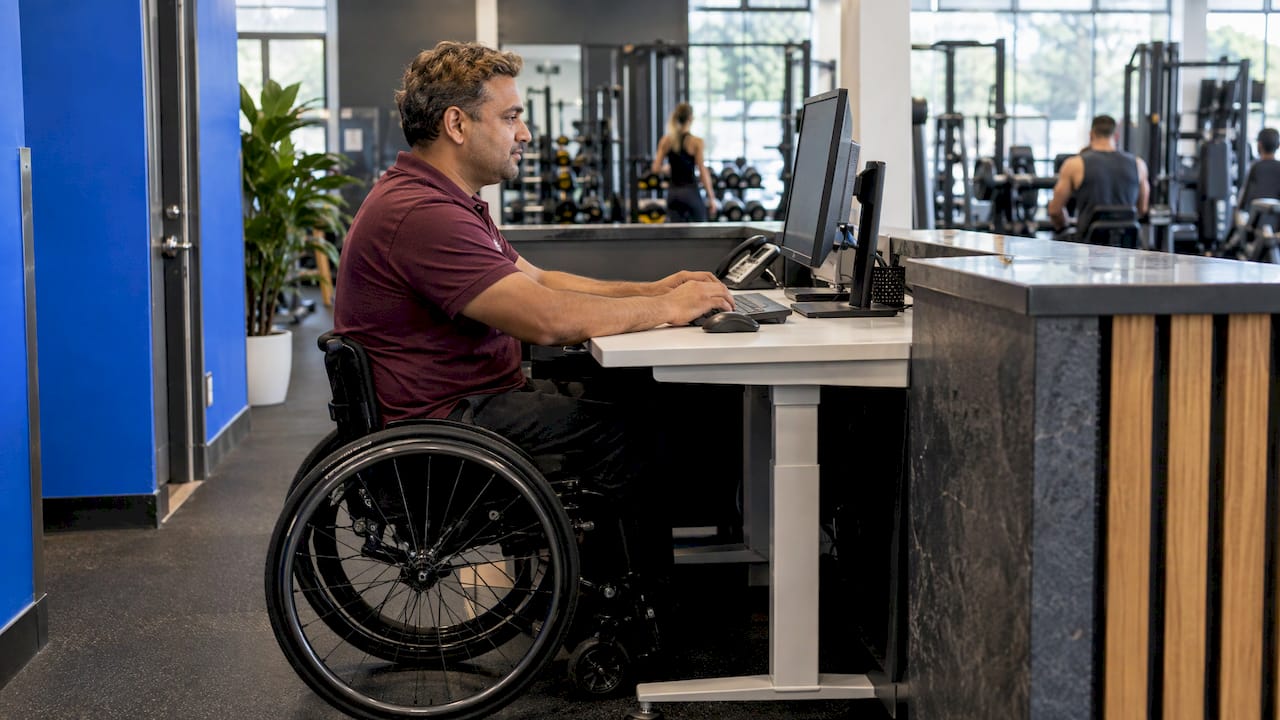
The Employment Assistance Fund (EAF) helps with cost. Under the November 2025 guidelines it covers reasonable workplace modifications, work equipment, Auslan services and workplace assistance, with a cap of $64,427 (GST exclusive) per application for modifications and equipment. Two rules matter in practice. Applications are not approved for items already bought or committed to, so apply first. And items an employer is obliged to provide, such as ergonomic equipment, are not funded by the EAF.
The EAF is a federal scheme and its figures are updated by the government, so check the JobAccess page for the current guidelines before you budget.
Disability employment services
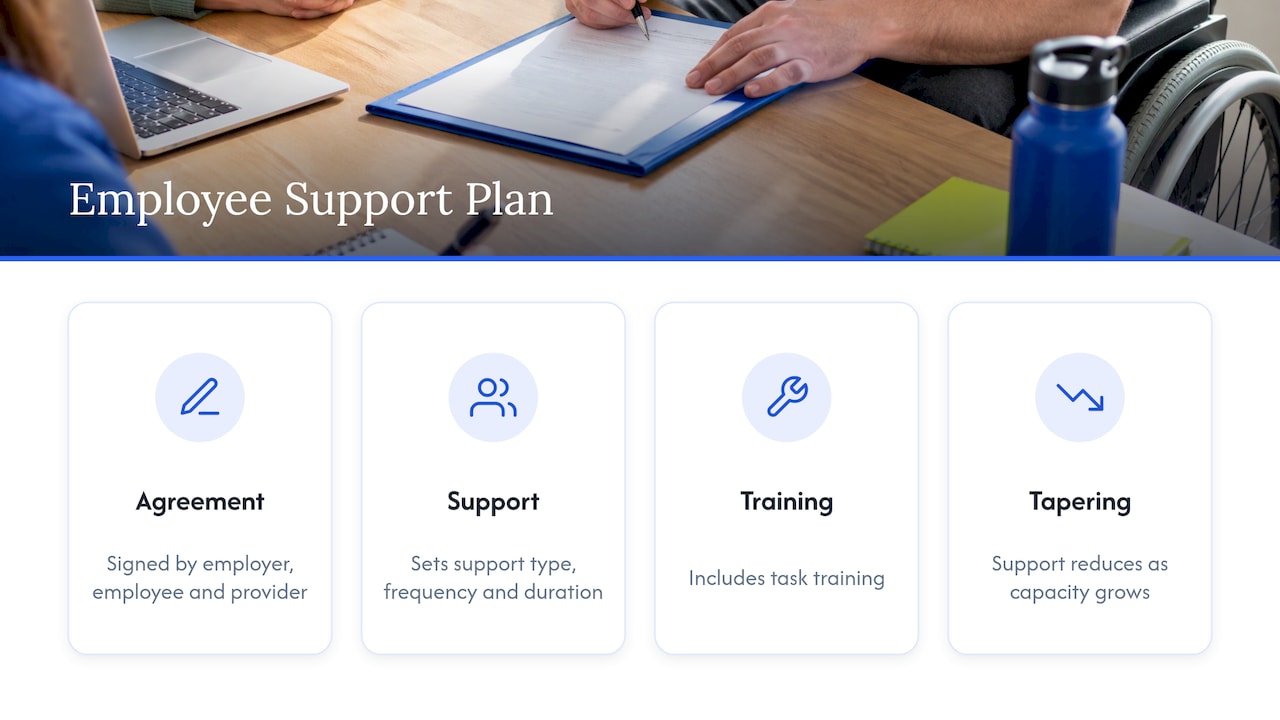
Since 1 November 2025, Inclusive Employment Australia has replaced Disability Employment Services as the federal specialist program. JobAccess’s guide to working with Inclusive Employment Australia explains that providers can help employers with recruitment, onboarding and retention, and can draw up an employee support plan signed by employer, employee and provider. That plan sets out the type, frequency and duration of support, task training, and how support reduces as the person’s capacity grows. Providers also offer ongoing support to help employees keep their job, including job redesign advice and referrals to health services.
If you want to understand how this system feels from the candidate’s side, our founder wrote about personal experiences with DES. It is useful reading for any manager who will work with a provider.
Step 5: Onboard so people stay
The Centre for Inclusive Employment lists the induction strategies that matter: an inclusive orientation, adjusted onboarding processes and nominated workplace buddies. It also recommends customising roles, providing adjustments and linking with specialist supports.
For a gym, a practical first-month plan looks like this:
| Stage | What to do | Who owns it |
|---|---|---|
| Before day one | Ask what the new hire needs, confirm adjustments are in place, send the roster in an accessible format | Manager |
| Day one | Walk the floor together, explain the systems, introduce the buddy | Manager and buddy |
| Week one | Check in on the adjustments, adapt the task list if needed | Manager |
| Weeks two to four | Review what is working with the employee, record changes | Manager and employee |
| Day 30 | Confirm ongoing supports and training needs | Manager and employee |
Write these steps down so that every hire gets the same quality of induction, not whatever the busiest manager remembers. A tool for documenting onboarding processes can help you capture the routine and the reasoning behind each adjustment, so the next manager does not start from scratch.
Where this goes wrong: gyms treat adjustments as a one-off at hiring. Needs change with the job, the roster and the person’s health, so build in regular check-ins.
Step 6: Train the whole team, not just the new hire
Hiring a trainer with disability into a team that has never thought about ableism sets that person up to carry the education load alone. The Australian Human Rights Commission says that demonstrating a commitment to accessibility and inclusion as organisational values is foundational to attracting people with disability. Values only count when staff can act on them.
That is where team training does its work. Colleagues need to know how to talk about disability, how to adjust a session, how to respond when a member or co-worker asks for something, and what ableism looks like on the gym floor. We cover that last point in ableism in fitness, and the basics of disability inclusion for gyms give managers a starting vocabulary.
For guidance aimed at sport and recreation employers, Disability Sport & Recreation, with Sport and Recreation Victoria and Victoria University, produced a guide on seeing capability before disability. It covers management commitment, recruitment and retention, and is worth reading alongside your own policy.
A safety note belongs here as well. Inclusion extends to how you run sessions. A disability risk assessment for gyms helps you identify hazards for staff and members with disability without excluding anyone by default.
A practical checklist for gym owners
- Position descriptions list essential requirements only, with a reason for each.
- Ads use plain language, carry a diversity statement and name a contact person.
- Application forms and your website work with assistive technology and meet WCAG 2.1 AA.
- Every candidate at interview stage is asked about adjustments.
- Interview and trial locations are physically accessible.
- Any automated screening is checked and never used to screen people out.
- A budget and process exist for reasonable adjustments, and someone knows how to apply for the EAF before buying.
- Induction includes a buddy and a 30-day review.
- Existing staff have completed disability inclusion training.
Our perspective
Most gyms we talk to want to hire inclusively and do not know where to begin. They often start with a policy document. We would start with the floor.
Our courses are co-designed with people with disabilities, and that shapes everything we teach. A lot of disability training patronises: it treats disabled people as problems to be managed or stories to be admired. Staff come away with warm feelings and no skills. We aim to give fitness professionals practical knowledge they can use on Monday morning, in plain language and without condescension.
For hiring, this matters because the interview is only the first moment of inclusion. The next thousand moments happen on the gym floor, in the staff room and on the roster. A new hire with disability needs colleagues who understand the social model of disability, who know how to adjust a session and who do not treat a request for an adjustment as a burden.
That is why we suggest training the team around the hire, ideally before the job ad goes live. Managers who understand the history and the social model make better decisions about job design, and trainers who understand real-world access barriers make better colleagues. All of our courses are CPD accredited, so the time your staff spend counts toward their professional development.
Tommy
Where to start with Inclusive-AF
If you want your team ready before you recruit, begin with our free introductory crash course, Train Clients With Disability. It gives you and your staff a shared starting point at no cost.
From there, our store has two courses that suit managers and owners shaping a hiring approach. The Social Model of Disability is A$40, and History of Disability in Australia is A$20. They explain why barriers exist and how attitudes and systems create them, which is the thinking behind a good position description and a fair interview. All of our courses are CPD accredited.
If you manage a larger team or an institution, we offer group and team enrolment. Our group training rollout plan shows how a gym can introduce training across a whole staff, and you can reach us through our main site to arrange it.
FAQ
Do gyms have to hire people with disability?
No law sets a quota for private gyms. The Disability Discrimination Act does make it unlawful to discriminate on the ground of disability in recruitment, which includes the arrangements for choosing who gets the job and the terms offered. Employers may decline a candidate only where the person could not meet the inherent requirements of the role even with reasonable adjustments.
What is a reasonable adjustment in a gym job?
It is a change that lets a person do the job or take part in recruitment on equal terms. Examples include a different roster, accessible equipment, a visual cueing approach for a hearing-impaired instructor, or extra time for an interview task. JobAccess describes them as including changes to the work area, equipment, services, work methods and tasks.
Who pays for workplace adjustments?
The employer has the obligation, but the Employment Assistance Fund can fund eligible modifications, equipment, Auslan services and workplace assistance, up to a cap of $64,427 (GST exclusive) per application under the November 2025 guidelines. It will not approve items you have already bought or committed to, so apply before you purchase.
Should I ask candidates if they have a disability?
Ask every candidate who reaches interview whether they need any adjustments, rather than asking about disability or diagnosis. This is the approach the Australian Human Rights Commission recommends. It keeps the focus on what the person needs to show their skills.
Is training my team part of inclusive hiring?
Yes. Recruitment is only the start, and retention depends on the culture a new hire joins. Training staff in disability inclusion before and after hiring helps colleagues support adjustments and avoid ableist habits. Our crash course is a free first step, and group enrolment covers whole teams.
Sources
- Inclusive Recruitment, Diversity Council Australia
- Inclusive Recruitment, Department of Employment and Workplace Relations
- Inclusive Recruitment Toolkit, DEWR
- Recruiting people with disability: employment and inclusion, Australian Human Rights Commission
- How to make your hiring process more accessible, JobAccess
- Guidelines on reasonable adjustments, JobAccess
- EAF Guidelines November 2025, JobAccess
- Working with Inclusive Employment Australia, JobAccess
- Disability Discrimination Act 1992
- Inclusive recruitment and induction, Centre for Inclusive Employment
- Inclusion guidelines for public aquatic facilities, Welcoming Cities
- Seeing Capability Before Disability, Disability Sport & Recreation