Inclusive onboarding for fitness staff means designing your induction so every new starter can take part from day one, including people with visible, invisible or episodic disability. In practice that comes down to four things: preparing before the person arrives, asking about access needs privately and only as far as the job requires, giving everyone the same disability-awareness grounding, and checking in often enough to fix what isn’t working. This guide walks through each step for Australian gyms, studios and pools.
TL;DR
- Start before day one: offer a workplace visit, check routes, bathrooms and equipment, and order any technology early.
- Ask job-related questions about adjustments, never for a diagnosis, and confirm who the new starter is happy for you to tell.
- Put disability awareness into induction for every team member, with extra depth for managers.
- Run the induction across the first day, week and month, then use regular check-ins to see whether adjustments still work.
- In Australia, the Disability Discrimination Act 1992 expects reasonable adjustments unless they cause significant detriment to the organisation.
Table of Contents
- Why inclusive onboarding matters in a fitness business
- Before day one: prepare the workplace and the person
- Asking about access needs while protecting privacy
- What the first day, week and month should cover
- Disability-awareness training as part of induction
- Reasonable adjustments and your legal footing
- Reviewing and improving the process
- A starter checklist for your next hire
- Build disability training into your induction
- FAQ
- Sources
Why inclusive onboarding matters in a fitness business
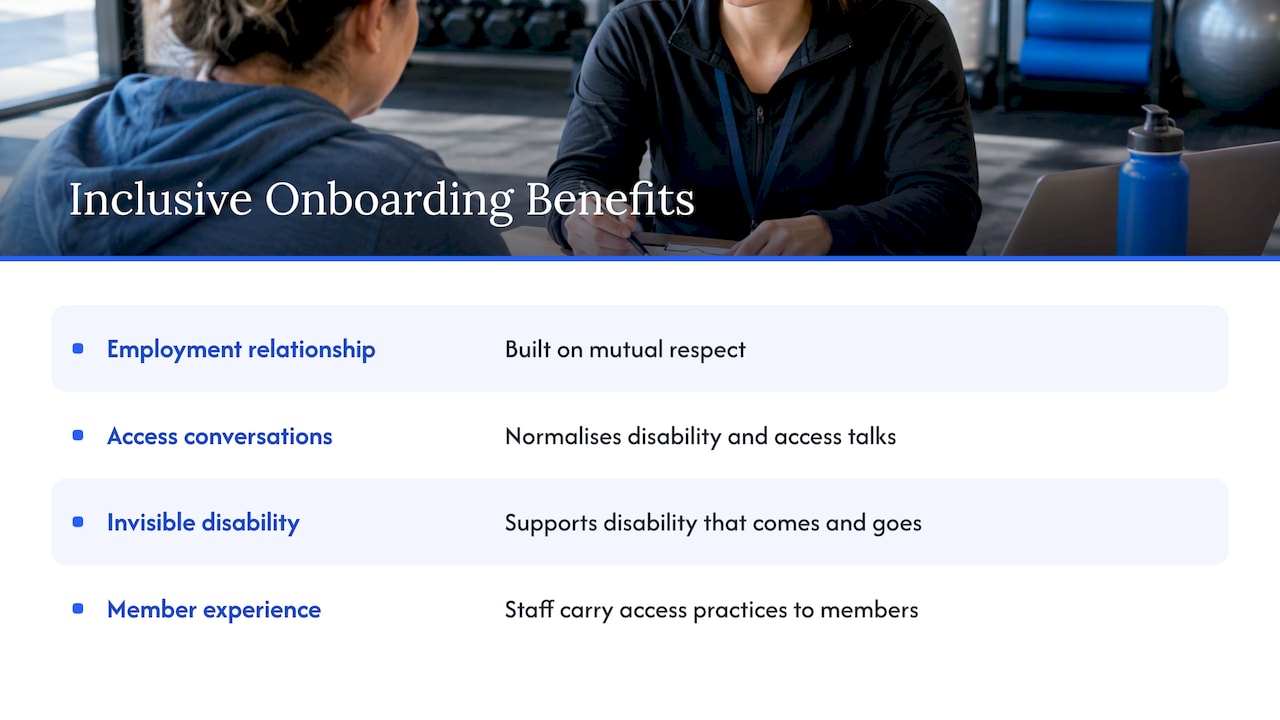
Onboarding is the first thing a new coach, front-desk worker or group-fitness instructor experiences of your culture. Australia’s IncludeAbility guidance says an inclusive induction sets the tone for a long-lasting employment relationship built on mutual respect. It also normalises conversations about disability and access, and it supports employees whose disability is invisible or comes and goes.
That last group is easy to miss. A new trainer with chronic pain, a neurodivergent reception hire or an instructor living with a mental-health condition may never look “disabled” to a manager, yet all of them benefit from an induction that treats adjustments as ordinary.
There is also a member-facing reason. The 2026 AUSactive Welcoming Fitness Environments report finds that inclusive fitness needs accessibility, staff education, lived experience and inclusive communication across the whole customer journey, not a one-off physical adjustment. Staff are where that journey is delivered. If your people join a team that handles access well, they learn what good looks like and carry it to members.
The Australian Human Rights Commission points the same way. Its guidance recommends inclusive language, disability representation, accessible staff events, disability-awareness training for all employees with emphasis on managers, disability action planning and senior disability champions. Onboarding is where most of those habits first show up.
Before day one: prepare the workplace and the person
The strongest inclusive onboarding happens before the new starter walks in. IncludeAbility recommends that employers offer a pre-start visit where appropriate, and make it optional. Some people want to see the space quietly before a busy first shift. Others don’t need it.
Walk the site as a new starter would
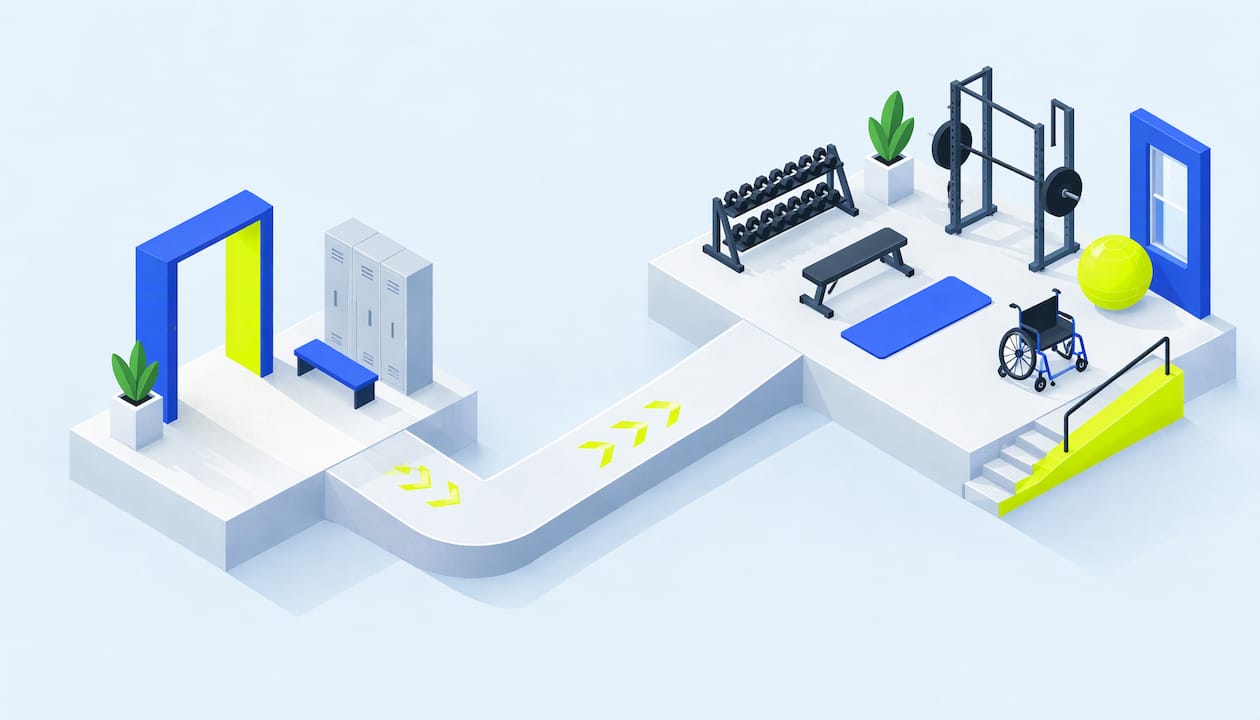
The same guidance suggests checking accessible bathrooms, ramps, lifts, uncluttered pathways and accessible equipment. In a gym, translate that into the places a staff member actually spends time:
- The route from the street or car park to the staff entrance, and from there to the floor, desk or pool deck.
- Staff bathrooms, lockers and break room, not just the member facilities.
- The front-desk workstation: height, seating, screen position, lighting and noise.
- Equipment the role uses, such as plinths, studio sound systems, point-of-sale terminals and rostering software.
- Floor-level clutter, such as stacked weight plates, stray mats and cables, which blocks wheelchair users and people with low vision.
If your changing areas are part of the walk-through, our guide to accessible changing rooms covers what gyms commonly miss.
Ask early about adjustments, and order early
Some adjustments take time. Software, a specialised chair or a captioning setup may need to be ordered, and IncludeAbility advises arranging these early where equipment or software must be ordered. Find out before the start date, in the offer or welcome email, what would help the person do the role well, and plan communication support too. Examples include an Auslan interpreter for the induction session, written instructions alongside verbal ones, or a quieter room for the first meeting.
Assign a buddy
A buddy is a colleague who answers the small questions: where to park, who covers the desk at lunch, how the roster app works. Choose someone who is approachable and reliable, and tell them what the role involves, not anything about the new starter’s health. The buddy is a peer, not a carer.
Asking about access needs while protecting privacy
This is the step where well-meaning managers go wrong. The goal is to learn what the person needs in order to work safely and well, not to collect medical history.
IncludeAbility suggests job-related questions: how the person’s disability relates to doing the job and working safely, how the workplace could be changed, and whether hours or rosters could be adjusted. It also advises confirming who the employee agrees may be told and telling staff about the new starter without disclosing disability unnecessarily.
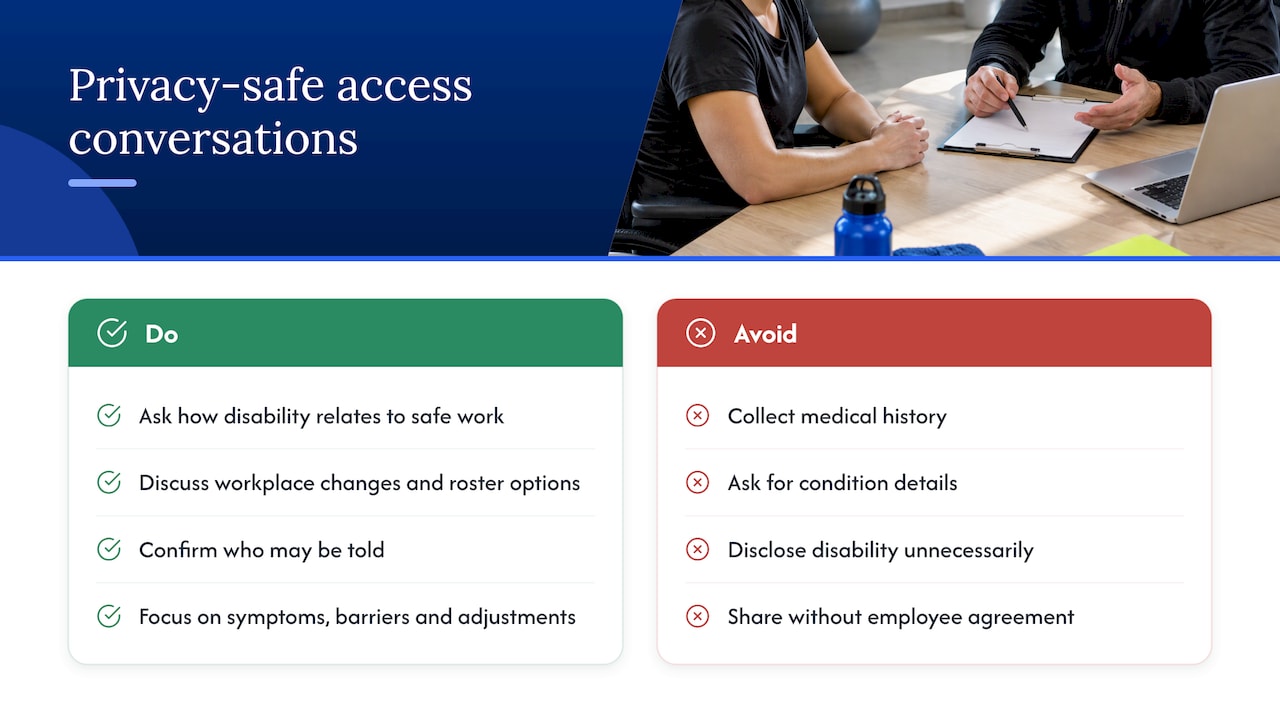
JobAccess adds two useful points in its Workplace Adjustment Passport. First, employees are generally not legally required to share disability information unless it affects the inherent requirements of the job or the safety of the employee or co-workers. Second, it recommends focusing on work-related symptoms, task barriers and effective adjustments rather than asking for details of a condition.
Questions that work, and ones to leave out
| Ask this | Not this |
|---|---|
| “Is there anything that would help you do this role well from the first week?” | “What’s your diagnosis?” |
| “Would a different roster pattern or start time help?” | “Will your condition make you unreliable?” |
| “Who are you comfortable with us telling, and what would you like them to know?” | Announcing a new starter’s disability at the team meeting |
| “Is there anything about the floor or equipment we should change?” | “Can you really do the physical side of this job?” |
If the person asks for the same thing as a colleague, such as a standing desk or written instructions, treat it the same way. Adjustments are not favours, and not every adjustment is about disability.
Write the agreement down
Record what was agreed, who knows, and when you will review it. A simple one-page note owned by the employee works well, and it saves them re-explaining everything each time their manager changes. If a manager presents the induction live to a group, an onboarding presentation script can help plan what to say slide by slide, so the access information is covered in plain words every time.
What the first day, week and month should cover
IncludeAbility’s guide frames accessible induction across the period before starting, the first day, the first week, and the first month and beyond, and says it is intended for all employees, including those with disability. That is a useful design principle: build one accessible process for everyone rather than a special track.
Day one
The guide’s list for the first day includes arrival and access procedures, workstation setup and adjustments, introductions to the team, workplace navigation and expectations, and whether a Personal Emergency Evacuation Plan is needed. For a gym, that means:
- Arrival: who meets them, where they enter, and where to go if the lift or door isn’t working.
- Setup: the adjusted workstation or equipment is ready before they sit down.
- Introductions: the buddy, the manager and the people they will work with most.
- Navigation: floor layout, quiet spaces, staff amenities and where to find help.
- Emergency plan: whether the person needs a personal evacuation plan, and who is responsible for it. This matters in multi-level studios and pool facilities.
- A written guide: an induction pack the employee can revisit, ideally in more than one format.
Keep day one short on information. A long list of policies delivered in one sitting is hard for anyone to absorb, and harder for people with attention, memory or fatigue-related needs.
First week
Spread the content out. Cover rostering, systems, incident reporting and member communication in smaller sessions, and check at the end of the week whether the adjustments are working. This is also when disability awareness training should begin (see below).
First month and beyond
Shift to development: professional development, training and performance expectations, discussed in the same regular check-ins as the adjustments. Employees with disability should have the same pathways to progression as everyone else.
Disability-awareness training as part of induction
JobAccess says disability-awareness training can establish shared understanding, reduce stereotypes and give staff practical skills and confidence when working with colleagues and customers with disability. It recommends making disability awareness a core part of induction and ongoing training, with general training for all staff and tailored training for managers or specific needs such as Deaf awareness, Auslan, blindness or mental-health awareness.
The fitness sector’s own body agrees. AUSactive’s 2026 report recommends mandatory disability awareness for all team members, investment in disability confidence, and pathways for people with disability to join the workforce.
What a good module covers
- How disability is understood: the social model, and why barriers sit in environments and attitudes rather than in people.
- Language and communication, including how to offer help without assuming it is wanted.
- The member journey, from enquiry and tour to a first session. Our guide to client communication accessibility goes deeper here.
- What ableism looks like on a gym floor, and what to do when you see it. See ableism in fitness.
- Reporting pathways and bystander strategies. Welcoming Cities’ guidance for aquatic facilities says training should cover unconscious bias, unwanted behaviour, bystander strategies and reporting pathways, and should be compulsory for managers.
Online, face-to-face, or both
Aquatics & Recreation Victoria notes that online training suits businesses with multiple locations, shift workers and high turnover because it is available at any time and keeps delivery consistent, while face-to-face sessions allow discussion, collaboration and role-play. It also reports that a large Australian leisure operator embedded a free online disability module into induction after internal evaluation, and that more than 7,000 of its employees completed it.
For most gyms the practical answer is a blend: an online module in the first week so nobody misses it on a split shift, then a short team conversation where people apply it to your own floor, desk and classes.
Avoiding the patronising trap
Training fails when it treats disabled people as objects of pity or inspiration. Signs of a good program: it was shaped by people with disability, it deals with real situations such as a member whose carer answers for them or a trainer unsure how to cue an exercise, and it gives staff skills rather than slogans. Participants should leave knowing what to do, not just feeling they should be kinder.
Our perspective: induction is where inclusion becomes habit
We build training for fitness professionals, and the pattern we see is consistent. Most people in this industry want to do right by clients and colleagues with disability. What they lack is practical knowledge, and most of what they’ve been offered is either a compliance tick-box or something that talks down to them and to disabled people.
That is why we think induction is the right moment. A new starter hasn’t yet picked up the shortcuts of the floor. If the first thing they learn is how to ask a direct question respectfully, how barriers get created and removed, and what a reasonable adjustment looks like, that becomes the default.
Our courses are co-designed with people with disability, all of them are CPD accredited, and they focus on real-world situations rather than awareness slogans. We would rather give your team a clear skill than a vague good intention. Start with the basics for everyone, then add depth for the managers and coaches who make decisions about people and spaces.
Tommy
Reasonable adjustments and your legal footing
In Australia, the Disability Discrimination Act 1992 (Cth) requires employers to make reasonable adjustments unless doing so would cause significant detriment to the organisation, such as financial hardship. IncludeAbility applies that to workplace barriers and to induction.
In practice, that means three habits:
- Treat an adjustment request as a problem to solve together, not a claim to be tested.
- Keep the focus on the inherent requirements of the role and on what removes the barrier.
- Take advice from the right source for complex cases. JobAccess is the Australian Government’s information service on workplace adjustments, and an employment lawyer or your state’s anti-discrimination body can advise on specific situations.
If you are also assessing how your venue handles risk for members, our disability risk assessment guide for gyms uses the same approach: identify the barrier, then adjust the setting.
Reviewing and improving the process
An induction is never finished at the end of week one. IncludeAbility recommends regular check-ins to see whether adjustments continue to work, and to ask new starters about disability awareness and confidence in the organisation. Use the same conversation to talk about professional development and performance expectations.
A simple review loop:
- Week one: is the setup working, and is the buddy helping?
- Month one: are adjustments still right, and has anything about the role changed?
- Every quarter: does the new starter feel able to raise access issues, and what would they change about the induction?
- Annually: update the induction guide, refresh manager training and add any gaps you have found.
Continuing professional development gives you a ready structure for step four. AUSactive says CPD supports safer, more effective and personalised programs and lists more than 800 evidence-based programs across exercise and active health topics. When you choose disability training for your team, check that it is CPD accredited so it counts toward your staff’s registration requirements.
A starter checklist for your next hire
- Add an access question to your offer letter or welcome email: what would help you in the first week?
- Offer an optional pre-start visit.
- Walk the route, bathrooms, workstation and equipment.
- Order any equipment or software at once.
- Name a buddy and brief them on the role, not the person.
- Agree in writing who is told what.
- Prepare a written induction guide in more than one format.
- Book disability-awareness training into week one.
- Diarise check-ins at one week, one month and one quarter.
If you run several sites or a franchise, a staged approach helps. Our group training rollout plan for gyms shows how to bring a whole team along without disrupting rosters. For the member side of the same effort, see the basics of disability inclusion for gyms and trainers.
Build disability training into your induction
If you want a ready-made module for the first week, we offer a free introductory course alongside paid modules such as The Social Model of Disability (A$40) and History of Disability in Australia (A$20). The Crash Course: Train Clients With Disability gives coaches practical skills they can use on the floor straight away. You can see everything on our course store.
Managing a team or several venues? Group and team enrolment lets you put the same training in front of every new starter, wherever and whenever they work.
FAQ
Do we have to ask new staff if they have a disability?
No. Ask what would help someone do the job well and safely, rather than whether they have a disability. JobAccess says employees are generally not required to share disability information unless it affects the inherent requirements of the job or safety. Make it easy to raise access needs at any time, not only in the first interview.
What should we do if a new starter doesn’t want colleagues to know about their disability?
Respect that. Confirm with the person who may be told and what they want shared, and let the team know about the new starter in the usual way without mentioning disability. The buddy only needs to know how to support the role. If an adjustment will be visible, such as a different roster, agree together how to explain it.
Is disability awareness training compulsory for gym staff in Australia?
Not as a general legal requirement for all gyms, but it is recommended practice. JobAccess recommends it as a core part of induction and ongoing training, and AUSactive’s 2026 report recommends mandatory disability awareness for all team members. Your obligations on reasonable adjustments under the Disability Discrimination Act apply either way.
How long should an inclusive induction take?
Plan it across the first day, week and month rather than a single session. Keep day one light, spread systems and training across the first week, and use check-ins in the first month to review adjustments and development. The exact hours depend on the role and the person’s preferences.
Can online training replace face-to-face induction?
It can carry the consistent core, especially for shift workers and multi-site teams, while a short in-person conversation covers your own venue and roles. Combining both gives staff flexibility and a chance to practise with colleagues.
Sources
- Creating an accessible and inclusive induction, IncludeAbility
- Recruiting people with disability, Australian Human Rights Commission
- Welcoming Fitness Environments full report, AUSactive
- Workplace Adjustment Passport, JobAccess
- Disability and awareness training for staff, JobAccess
- Train staff, Aquatics & Recreation Victoria
- Inclusion guidelines for public aquatic facilities, Welcoming Cities
- CPD Courses, AUSactive directory