
Inclusive class programming means designing a group session so that people with different abilities can take part in the same class, with the options built into the plan rather than improvised on the floor. In Australia, the national unit for planning group exercise describes it as designing sessions for mixed-ability groups and preparing modifications for use during instruction. Done well, it protects your participants, meets your legal duties and fills your timetable. The fastest way to build the skill is structured training co-designed with people with disability, which is what we teach at Inclusive-AF.
TL;DR
- Plan for the whole group first: goals, abilities and needs, then exercises, equipment, volume and intensity, with modifications written into the plan.
- Show seated and standing options as equal choices, and drop language that ranks versions as easier or harder.
- Ask participants what they need, speak to them directly and never assume.
- The Disability Discrimination Act 1992 makes exclusion from services and sporting activity unlawful, subject to its exceptions, so adjustments are part of your duty, not a favour.
- Our free introductory crash course is a low-risk way to start building these skills in your team.
Table of Contents
- What inclusive class programming means in a gym
- Plan the session around the group, not the exercise list
- A worked example: one circuit class, three entry points
- Present options without ranking people
- Communication that works for the whole room
- Ask, don’t assume
- Set up the room and the timetable
- Your legal and safety duties in Australia
- Rolling out inclusive programming across a team
- Where our training fits
- Our perspective
- FAQ
- Sources
What inclusive class programming means in a gym
Most group classes are built around an imagined average participant, then adjusted when someone who does not fit walks in. Inclusive programming reverses that order. You start with the full range of people who might attend and build the session so that nobody needs a separate, lesser version.
A European expert consensus study on inclusive physical activity landed on a few principles that fit group fitness well. It named participant-focused planning, involving disabled people, focusing on ability rather than disability and equal opportunity as core. Its main strategies were adapting rules and aims, adapting teaching methods, ensuring accessibility and hearing participants’ voices.
That last point matters most. Inclusion is not something you do to a class. It is something you design with the people who use it.
Why the keyword is confusing
Search this phrase and you will find school classrooms and coding lessons. In fitness it has a specific meaning: the structure, content and delivery of group exercise sessions such as circuits, strength classes, aqua, yoga, dance-based classes and boot camps. The same principles carry across from education, but the evidence in this article is about exercise settings.
Plan the session around the group, not the exercise list
The Australian unit SISFFIT035 sets out a planning sequence that is a solid backbone for any instructor. Its planning steps are:
- Identify participants’ goals, characteristics, abilities and needs.
- Select suitable exercises, techniques and equipment.
- Plan volume and intensity for the group.
- Prepare modifications for use during instruction.
- Review feedback and improve future sessions.
The unit applies to group fitness instructors and personal trainers working in gyms, leisure centres and community centres, so it covers most of the places inclusive classes happen.
Step 1: Find out who is coming
Gathering information sounds simple, but it is where most plans go wrong. A generic health questionnaire tells you about conditions. It does not tell you what a person needs from a class. Ask open questions: what helps you take part, what makes a class hard, how do you like instructions given?
University-based guidance on inclusive exercise classes suggests sharing class information in advance and inviting participants to describe their access needs. It also recommends offering a one-to-one preview or trial so people know what to expect before they walk into a room of strangers. A preview removes much of the anxiety that keeps people away from group classes.
Step 2: Choose exercises with range built in
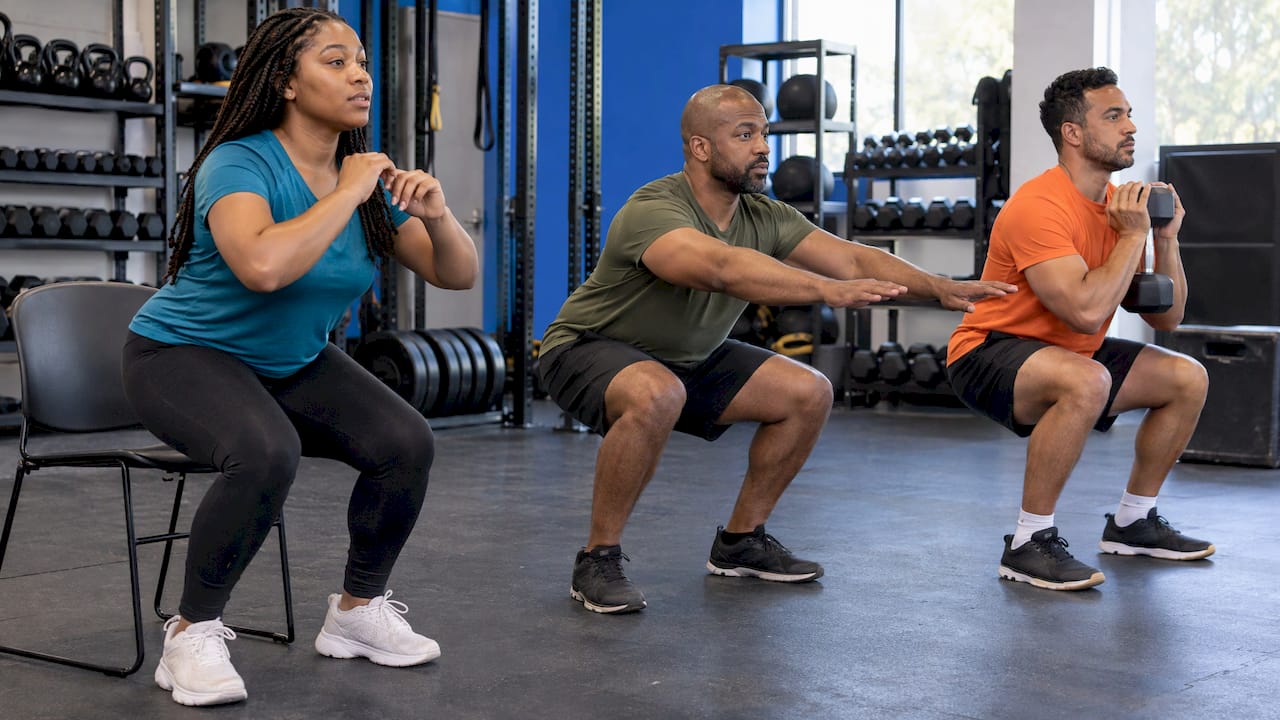
Pick movements that have natural variations along a spectrum, not a single “correct” form plus a list of exceptions. A squat pattern can be a sit-to-stand from a chair, a bodyweight squat or a loaded squat. A pushing pattern can be a wall press, a bench press or a floor push-up. Each version trains the same movement. None is a consolation prize.
This is the stage where condition-specific knowledge pays off. If your regulars include people with stroke, arthritis, cerebral palsy, Ehlers-Danlos syndrome or spinal cord injury, the choices change. We have practical guides on stroke exercise adaptations, arthritis exercise modifications, cerebral palsy exercise, Ehlers-Danlos exercise and training clients with spinal cord injury.
Step 3: Set volume and intensity for a spread of capacities
Give participants control of their own dose. Offer work intervals with self-selected effort, rest options that look like part of the class and clear permission to pause. A simple method is to design every block with three entry points, then let people choose.
Step 4: Write the modifications into the plan
A modification you think of mid-class is a modification you will forget or deliver clumsily. Write them beside each exercise in your session plan, including equipment changes, positioning and cues.
Step 5: Review and adjust
After each session, ask what worked. The ACSM Health & Fitness Journal advises organisations to continually evaluate inclusion with disabled participants, community experts and advisory structures. For one instructor, that can be as simple as a regular two-question check-in.
A worked example: one circuit class, three entry points
Take a 45-minute circuit with six stations. A traditional plan lists burpees, kettlebell swings, step-ups, rows, planks and skipping. An inclusive plan keeps the same energy and rewrites each station as a movement goal.
| Station goal | Option A | Option B | Option C |
|---|---|---|---|
| Full-body power | Seated medicine ball throw | Standing slam | Slam with a jump |
| Lower-body drive | Sit-to-stand from a chair | Step-up to a low box | Step-up to a high box |
| Pulling | Seated band row | Standing band row | Suspension row |
| Core | Seated trunk rotation with band | Dead bug | Plank |
| Cardio | Seated arm cycling or punches | Marching on the spot | Skipping |
| Pushing | Wall or incline press | Bench or floor press | Push-up |
Notice the labels: A, B and C, not “easy” and “hard”. Each option is a legitimate way to do the station, and the instructor presents all of them at the start of every round.
Present options without ranking people
How you describe options shapes who feels welcome. The university guidance recommends showing seated and standing options, presenting seated options first, avoiding language that ranks versions as easier or harder, and making clear that different ways of moving are welcome.
In practice:
- Demonstrate the seated version first, as a full exercise, not as an afterthought.
- Say “choose the option that suits you today”, not “if you can’t do that, try this”.
- Avoid words like “modified”, “regression” or “the real one” in front of the group.
- Make sure everyone can see and hear the demonstration from where they are.
This is the area where training that is co-designed with people with disability makes a visible difference. Well-meant language can still patronise, and instructors rarely hear that feedback unless someone with lived experience gives it to them. It is the gap our courses are built to close.
Communication that works for the whole room
The Inclusion Alliance fitness toolkit, an Australian resource, recommends clear, brief instructions, specific directional language, facing participants, reducing competing noise, checking understanding, using visual aids and demonstrations, and communicating directly with the participant rather than through a third person.
The university guidance adds a visual schedule or consistent routine, lower music volume while instructing, and a mix of spoken, visual and modelling methods. A consistent class structure helps everyone, including people who find change in routine stressful.
A practical script for the first minute of a class:
- Say your name and describe the room: where the exits, toilets and equipment are.
- Outline the session in three or four blocks, ideally with a visual schedule on the wall.
- Introduce the options for each block and invite people to choose.
- Lower the music before you give instructions, then bring it back up.
For a deeper look, see our guide to client communication accessibility in fitness.
Ask, don’t assume
The NDIS Business Support Lab gym tip sheet advises staff to ask rather than assume whether help is wanted, speak directly to the participant, respect privacy, offer guided introductions, identify adaptable exercises and equipment, and keep routes clear for mobility aids. It also recommends patience when someone needs more time, easy-read documents and an Access Key showing accessible parking, toilets and support arrangements.
A few habits make “ask, don’t assume” concrete:
- Offer help once, then accept the answer.
- Never discuss a participant’s needs in front of the group.
- Let support workers enter flexibly, as the same tip sheet suggests, and talk to the participant, not the support worker.
- Keep walkways clear and tell people before you move equipment.
Set up the room and the timetable
Inclusive programming extends past the exercises. Your space and schedule decide who can come at all.
The ACSM journal recommends accessible layouts with enough room for wheelchair travel, folding chairs for rest, quieter spaces for sensory breaks, clear task instructions and an organisational culture that addresses attitudinal barriers. The Australian tip sheet adds sensory-friendly times with lower lighting, quieter music and fewer people.
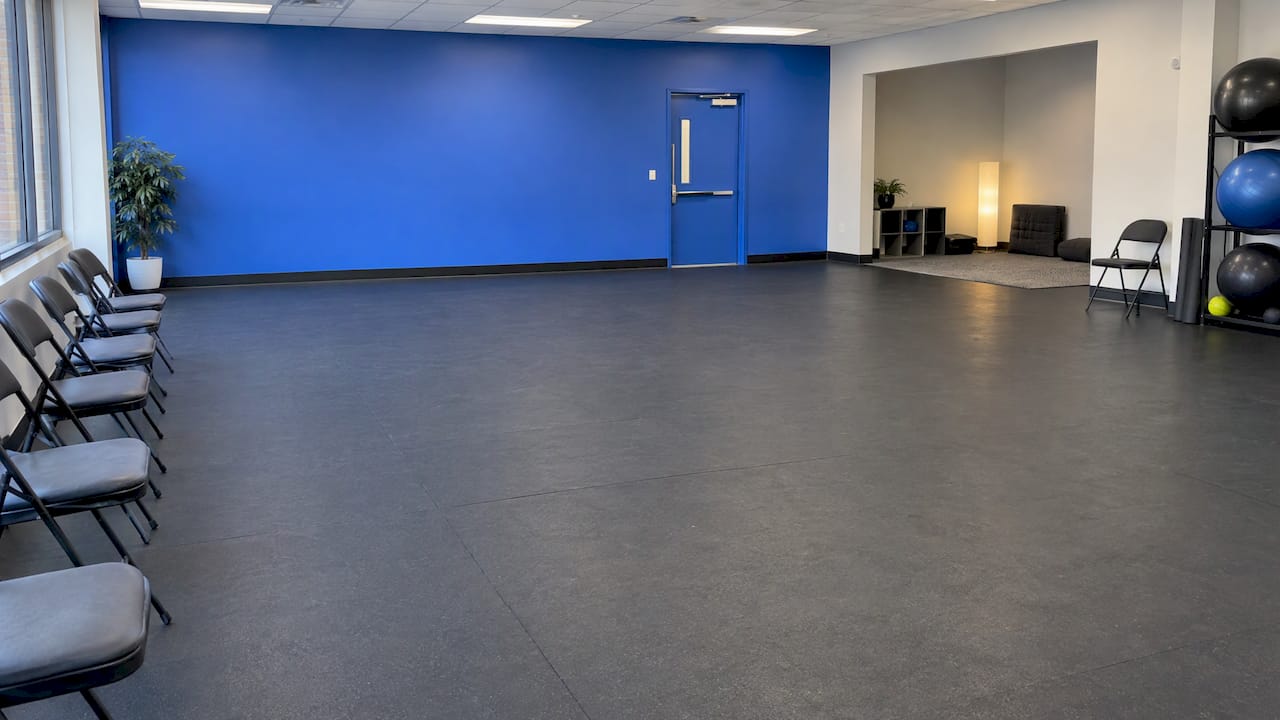
Class size is part of this. Smaller numbers leave room for mobility aids and one-to-one attention. Writing down a clear class size policy helps you protect that space and explain it to participants. For environments that need extra care, read our guides on sensory-friendly gym design and what makes an autism-friendly gym work.
Your legal and safety duties in Australia
Inclusion is also a compliance matter. Under the Disability Discrimination Act 1992, it is unlawful for providers of goods, services or facilities to discriminate because of disability in refusing access, setting terms and conditions, or the manner of providing the service. Section 28 also prohibits excluding a person from a sporting activity, including administrative or coaching roles, subject to the Act’s exceptions.
The practical consequence is reasonable adjustments. Victorian Equal Opportunity guidance explains that these can include accessible equipment, parking, toilets, corridors, formats and communication aids, and that they are expected unless they cause major difficulty or unreasonable cost, or would be ineffective.
Ordinary safety obligations still apply. If you run classes in public space, councils set conditions:
- The City of Gold Coast requires a suitable first-aid kit, a clean area and locations that do not endanger or obstruct other users for commercial fitness sessions in parks.
- The City of Port Phillip’s 2024 fitness training policy requires a pre-site safety check and temporary exclusion zone, and restricts classes near hazards such as playgrounds, pathways, stairs and sportsgrounds.
Check the conditions of your own council and, for legal questions about a specific situation, speak to a lawyer or the Australian Human Rights Commission. A written process helps: our disability risk assessment guide for gyms walks through one for Australian facilities.
Rolling out inclusive programming across a team
One trained instructor is a start. A timetable that is inclusive only when that person is on shift is fragile. Gym owners get a consistent result when every instructor shares the same language, the same planning template and the same understanding of why it matters.
The ACSM journal recommends disability-specific staff training and including people with disabilities in planning, using their first-hand accounts rather than assumptions. A workable rollout looks like this:
- Audit your current timetable against the planning steps above.
- Train all instructors, front-of-house staff and managers together.
- Pilot one or two redesigned classes and collect participant feedback.
- Publish what each class involves so people can choose with confidence.
- Review quarterly.
We lay out a fuller version in our group training rollout plan for gyms, and the basics of disability inclusion in fitness cover the foundations for anyone new to the topic.
Where our training fits
Inclusive-AF provides online training modules for fitness professionals, gym owners and institutions on disability inclusion, accessibility and evidence-based support for clients with disabilities. Our courses are CPD accredited, and they are built with people with disabilities so that the language and practice you learn do not patronise.
You can begin with our free introductory crash course, Train Clients With Disability. Two paid modules suit instructors who want the background behind their programming: The Social Model of Disability at $40 AUD and History of Disability in Australia at $20 AUD, both listed in our store. If you are training a whole team, group and team enrolment is available.
Our perspective
Most instructors who come to us already care. What they lack is a plan they trust and language that does not make people feel managed.
We think inclusive class programming is a design skill, not a kindness. You decide the entry points before the class starts, you offer them as equals and you keep asking participants what works. The people who teach you best are the ones who use your classes.
That is why our courses are co-designed with people with disabilities and focus on practical skills, not awareness slogans. A team that shares one approach gives every participant the same welcome, whichever instructor is on the floor.
Tommy
FAQ
What is inclusive class programming in fitness?
It is planning a group exercise session so that people of different abilities can train together, with options, equipment and communication designed in advance. In Australia, the national group exercise planning unit describes this as planning for mixed-ability groups and preparing modifications for use during instruction. It applies in gyms, leisure centres and community centres.
Do I need a separate class for participants with disability?
Not as a default. The inclusive approach is to design one class with several valid options, so people choose how to take part. Some participants may prefer a quieter or sensory-friendly session, and offering those times as part of your timetable gives people a choice.
How do I find out what a participant needs?
Ask them, ideally before their first class, and ask in an open way. Guidance recommends inviting participants to describe their access needs and offering a one-to-one preview. Speak to the participant directly and keep what they tell you private.
Does the law require me to make adjustments?
The Disability Discrimination Act 1992 makes discrimination in providing services and facilities unlawful, and Victorian guidance says reasonable adjustments are expected unless they cause major difficulty or unreasonable cost. For advice on a specific situation, consult a lawyer or the Australian Human Rights Commission.
Where can my team get CPD-accredited training?
Our courses at Inclusive-AF are CPD accredited, and the free introductory crash course is a good first step. Teams can use group and team enrolment through our main site.
Sources
- National Training Register: SISFFIT035 Plan group exercise
- Principles and strategies of inclusive physical activity (PMC)
- Inclusive Exercise Classes: guidance for fitness professionals
- Inclusive Fitness toolkit, Inclusion Alliance
- NDIS Business Support Lab gym tip sheet
- Disability Discrimination Act 1992
- Victorian Equal Opportunity guidelines
- City of Gold Coast commercial fitness training permit
- City of Port Phillip fitness training policy 2024
- ACSM Health & Fitness Journal: steps for community fitness organizations