A gym becomes inclusive when people with disability help shape it, and a community partnership is the way that happens. Australian government guidance tells organisations to partner with disability specialists so that they can improve accessibility, find participants and build trusted relationships. For a gym, studio or training business, that means working with disability organisations, local services and lived-experience leaders from the start, and pairing those relationships with staff who know how to train clients with disability.
TL;DR
- A community partnership is a long-term, two-way working relationship with disability organisations and people with lived experience. It is not a one-off donation, a flyer drop or an “inclusion day”.
- Start by assessing your own readiness, then agree a shared purpose, roles and how you will measure success before you launch anything.
- Ask about access needs, pay people for their time and report back on what changed because of their input.
- Partners open doors, but your staff still have to deliver the session. Training the team is what makes the partnership work on the gym floor.
- NDIS funding for social and community participation is changing, so partnerships that give participants a welcoming, local place to train matter more.
Table of Contents
- What a community partnership means for a gym
- Why participation is more than turning up
- Who to partner with
- Five steps to build a partnership that lasts
- Where the partnership meets the gym floor
- The funding context in Australia
- A note on avoiding patronising partnerships
- Train the team your partners will meet
- FAQ
- Sources
What a community partnership means for a gym
In fitness, the word “partnership” gets used loosely. A sticker in the window, a single wheelchair-accessible class or a sponsored event is not one. A partnership is an ongoing arrangement where a disability organisation, a service provider or a group of people with disability and your business each contribute something and each get something back.
The Australian Disability Inclusion for Local Government Guide describes what this looks like in practice: long-term relationships with disability organisations and community groups, support for peer-led and disability-run activities, co-design with local organisations, regular contact with disability services, and co-funding for accessible programs. Local councils wrote it, but the same logic applies to a single gym or a multi-site operator.
For your business, the practical forms are usually:
- Referral relationships with disability support providers, support coordinators and allied health clinics, so people know your gym exists and what it can offer.
- Co-designed programs, such as a mixed-ability class or an accessible aquatics program, built with the people who will use them.
- Advisory relationships, where a disability-led organisation or individual reviews your facilities, communications and onboarding.
- Shared events and pathways, such as a community recreation group using your facility at set times, with trained staff on hand.
Why participation is more than turning up
Partnerships matter because being present in a building is not the same as taking part. A Deakin University evaluation of the My Active Life program found that recreational inclusion meant more than presence. Participants linked it with dignity, respect, welcome, confidence and identity. The same evaluation reported personal growth, better mental wellbeing, new relationships, social closeness and increased independence. Its activities included swimming, bike riding, walking, calisthenics and social nights, which are all things a gym or community fitness provider can host.
A 2022 umbrella review of interventions for social and community participation adds a useful rule. It found that better participation needs purposeful strategies that identify what people want: where, when, how and with whom. It also needs support that builds capacity or makes ongoing participation possible. The review concluded that community capacity building, peer support and advocacy may be needed to make communities more accessible and give people real choice.
For a gym owner, that is a clear brief. Don’t guess what people want. Don’t expect a disabled person to adapt to a standard timetable. Build the relationships that tell you where, when, how and with whom people want to train, and train your staff so they can offer it.
Who to partner with
The Disability Gateway guidance gives a simple order of work. Identify the expertise you need, contact potential partners early, accept that they may not have capacity, discuss services and costs openly, and ask for referrals to other specialists. Disability specialists can help you improve accessibility, recruit participants or allies, facilitate sessions and give insight into a project.
For a fitness business, the groups worth approaching are:
| Partner type | What they can bring | What you bring |
|---|---|---|
| Disability-led organisations and peer networks | Lived-experience insight, access audits, trust with their members | A paid role, a venue, a willingness to change |
| Disability support providers and support coordinators | Referrals, knowledge of participants’ goals, support workers who can attend | A welcoming, trained team and clear session information |
| Allied health clinics | Clinical context for individual clients | A place to continue training safely |
| Local councils and community hubs | Access to local networks, sometimes co-funding | Programs that meet local needs |
| Schools, TAFEs and community colleges | Youth and transition pathways | Work placements, recreation programs |
The Inclusive Futures guide on partnering for disability inclusion describes a division of labour that is easy to borrow. One partner supplies training and audit tools, organisations of people with disabilities carry out the accessibility audits, and the local authority commits to the changes. In a gym setting, you are the one who commits to the changes, so you need the audit from someone with lived experience and the training for your own team.
Five steps to build a partnership that lasts
1. Check your own readiness first
The Western Australian government’s Communities Partnerships Framework recommends starting with a readiness assessment of your organisation’s capacity, capability, benefits and risks before you select partners. For a gym, ask plain questions. Can your staff explain how the facility is accessed? Do you have a process for a new client who tells you about an access need? Who has authority to change a class format?
Our disability risk assessment guide for gyms walks through this from a safety and operations angle. A partner will ask the same questions, so it is better to have honest answers before the first meeting.
2. Hold an exploratory meeting with clear aims
The same framework says early meetings should establish trust, a shared purpose, mutual benefits, ground rules, expected outcomes, activities, membership, responsibilities, structure and lifespan. Write these down. A one-page summary after the first meeting prevents most later confusion about who does what.
Ask partners what they want, and do not arrive with a finished program. Offer payment for their time and expertise at the start, not after they have given it.
3. Make engagement accessible
The Department of Social Services’ Good Practice Guidelines say engagement should be early, intentional, respectful and continuous. They advise asking about access needs, providing accessible materials and venues, paying participants, and telling them what impact their contributions made.
Victoria’s better practice guide for inclusive engagement gets specific. It recommends offering several ways to take part, using interpreters, captions, plain language and Easy Read, and checking venue access, lighting, quiet spaces, transport, bathrooms and support-worker access. Apply that list to your own meeting room, your front desk and your website. Our guide to client communication accessibility covers the fitness-specific version.
4. Agree roles, and keep people engaged
Inclusive Futures identifies two foundations for these partnerships: shared understanding, built through assessment and tailored training, and clear roles and responsibilities, with partners kept engaged through something like a steering committee. For a single gym, a quarterly catch-up with a small advisory group does the same job.
Decide in writing who handles referrals, who runs sessions, who responds to feedback and who pays for what. Settle what happens if a session does not suit a participant. Settle how long the arrangement runs and when you will review it.
5. Measure what the community says matters
Victoria’s guide says success measures should be shaped by the community. They can include stronger relationships, program engagement, use of community insight, paid leadership opportunities, improved practice, employment of people with lived experience, and reporting impact back to the community. Attendance numbers alone will not tell you whether people felt welcome. Ask participants and team members about their experience, as the Good Practice Guidelines suggest, and publish what you changed as a result.
Where the partnership meets the gym floor
Partners can refer people to you and audit your space, but the experience is delivered by the trainer or instructor in front of the client. That is where many partnerships stall: the disability organisation sends a participant, and the staff member has never trained someone who uses a wheelchair, has an intellectual disability or experiences sensory overload.
So plan training alongside outreach. An inclusive onboarding process for new staff means the first conversation with a new client goes well. Specific knowledge helps too, for example our guide on training clients with spinal cord injury or on what makes an autism-friendly gym work.
Physical access is the other half. People need to find the accessible entrance, the quiet room and the changeroom without asking. Clear wayfinding signage planning is a good example of an improvement that an access audit often points to and that costs little compared with its effect.
The funding context in Australia
Many of the people a gym partnership reaches use the NDIS, so it helps to understand how that funding is moving. The NDIS lists supports for community, social and recreational participation, including assistive equipment for recreation, group and centre-based activities and support coordination. Support coordination helps participants connect with informal community supports, funded supports and mainstream services, which is why coordinators are valuable partners.
The settings are changing. People with Disability Australia describes reductions to social and community participation budgets of 50% for participants who receive a new or reassessed plan from 1 October 2026, with a 10% reduction for capacity-building daily activities, and with critical supports excluded. ABC News reported in April 2026 that the average social-participation budget was proposed to fall from about $33,000 to $26,000, while the government also announced a $200 million Inclusive Communities Fund for community organisations.
For a gym, the lesson is practical. As funded participation supports tighten, people will look for local, mainstream places where they can train with trust and without a large support package. Gyms with trained staff and real community relationships are well placed to be those places. The NDIS also published pricing updates effective 24 November 2025 with revised descriptions for community social and recreational activities and community participation activities, so talk to partner providers about how their funded activities are described before you design a shared program. Always check current NDIS settings on the official site, as they change.
A note on avoiding patronising partnerships
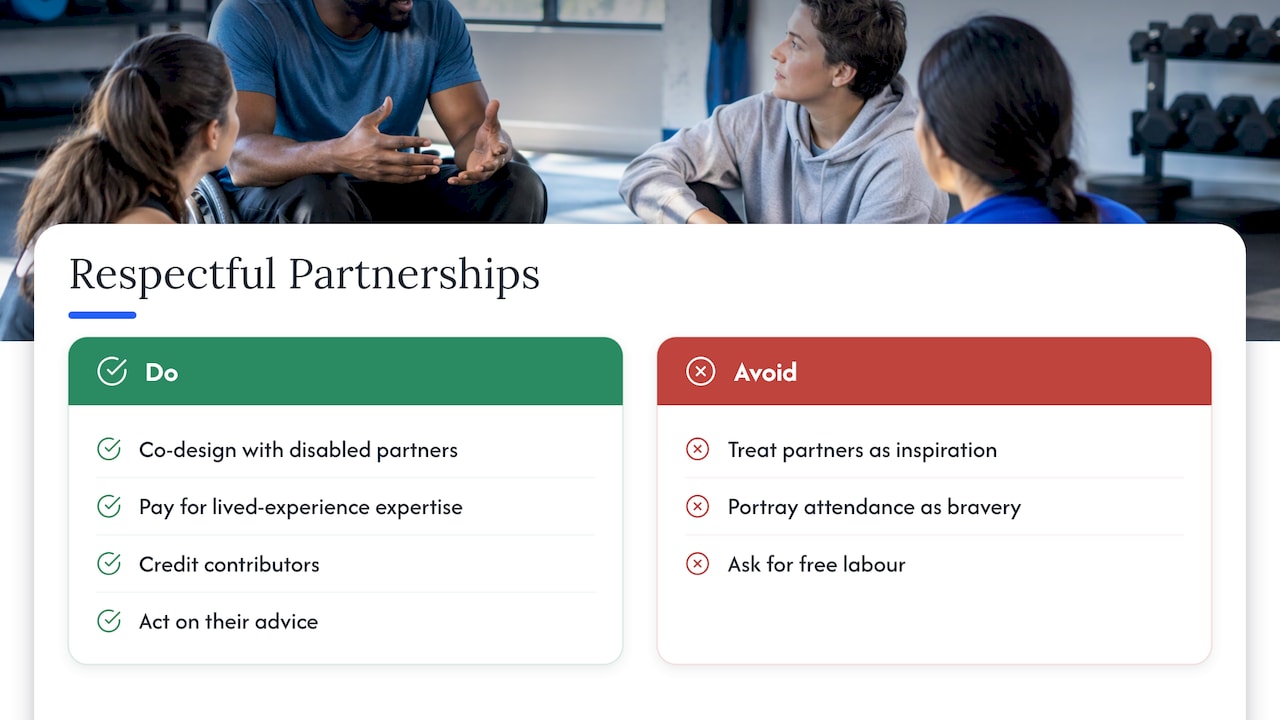
Good intentions can still produce the wrong outcome. The most common failure is treating partners as an audience for your inspiration rather than as co-designers. Words matter here: people with disability have said clearly that they don’t want to be anyone’s inspiration, and it is worth reading one writer’s view on exactly that. If your marketing for the partnership shows disabled people as brave for turning up, rewrite it.
The other failure is asking for free labour. Lived-experience advice is expertise. Pay for it, credit it and act on it.
What we think
We built Inclusive-AF because most disability training for fitness professionals talks down to the people it is about. Our modules are co-designed with people with disabilities and focus on practical knowledge: what to do in the first conversation, how to adjust a session, how to avoid language that patronises.
Partnerships are where that knowledge gets used. A disability organisation can send you clients and tell you what is missing, but your team has to be ready when they arrive. That is why we think the order matters: learn the foundations, build the relationships, then run the program. Our courses are CPD accredited and validated for industry requirements, so the time your team spends learning counts toward their professional development too.
If you do one thing this quarter, make it a conversation with a disability-led group about what they want from a gym, and then train your team to deliver it.
Tommy
Train the team your partners will meet
Partnerships work when staff have a shared base of knowledge. Inclusive-AF offers online training modules for fitness professionals, gym owners and institutions. The Crash Course: Train Clients With Disability is a free introductory course, a low-risk way for a trainer or a whole team to start. For context on how attitudes and systems shaped today’s barriers, The Social Model of Disability is $40 AUD and History of Disability in Australia is $20 AUD, both one-off prices.
Gyms, institutions and teams can use group and team enrolment so everyone starts from the same understanding before a partnership launches.
FAQ
What is a community partnership in disability inclusion?
It is an ongoing working relationship between an organisation and people or groups in the disability community, with shared goals, agreed roles and a way to review results. It differs from a one-off event because both sides contribute and both benefit. Government guidance stresses that engagement should be early, intentional, respectful and continuous.
Who should a gym approach first?
Start with a disability-led organisation or peer network in your area, and with local support providers and support coordinators. Contact them early, discuss costs openly, and ask for referrals to other specialists if they cannot help. Your local council’s disability inclusion officer can often point you to the right groups.
Do we have to pay partners?
Yes, where partners give their time and expertise. The Good Practice Guidelines advise paying participants, and Victoria’s guide lists paid leadership opportunities and employment of people with lived experience among its success measures. Agree the payment at the first meeting, so no one is left guessing.
How do we know the partnership is working?
Decide on measures with your partners before you start. Useful ones include stronger relationships, program engagement, how you used community insight and whether people feel welcome. Ask participants and staff for their experience, then report back on what you changed.
Does our staff need training before we approach partners?
It helps a great deal. Partners will refer people only if they trust your team to deliver, and training gives every staff member the same foundation. A free introductory course is an easy way to begin, followed by modules on specific topics as the partnership grows.
Sources
- Partner with disability specialists, Disability Gateway
- Partnering for disability inclusion, Inclusive Futures
- Disability Inclusion for Local Government Guide
- An investigation of inclusive sport and recreation, Deakin University
- Interventions for social and community participation, 2022 umbrella review
- Communities Partnerships Framework, Government of Western Australia
- Good Practice Guidelines for Engaging with People with Disability
- Better practice guide for inclusive engagement, Victorian Government
- Supports that are NDIS supports, NDIA
- NDIS changes start today, People with Disability Australia
- Minister’s pricing determination, NDIS
- NDIS social funding cuts, ABC News
- Medical office wayfinding, CrispSign Blog